Tuesday, March 18, 2025

Thrift Store Scores

As regular readers here might already know, I love thrifting. I have always enjoyed it - but it's not just that I am cheap, I also love keeping fabrics, patterns and notions in use, so they don't end up wasted in landfill somewhere. 

I haven't been doing as much thrifting over the last while, partly because the weather for the first couple of months of this year was so dreadful I wasn't going anywhere - and partly because I am trying to sew from stash first. 

But I did end up doing some shopping this month! These are the fabric treasures I've found recently. Some black broadcloth right at the bottom (always useful), some silky  linings that I adore, a synthetic checkerboard print, some yellow cotton, a pillowcase with an interesting print, and a couple of fat quarters of quilting cotton. It's a wide variety and we'll see if I use any of it up soon. I enjoy finding interesting options while thrifting, especially odd prints that are more unusual. 


I also picked up a couple of older patterns, one of my favourite things to collect. I am particularly drawn to the white blouse in the Butterick pattern. Lots of interesting details in both though! I always seem to gather more than I can reasonably use but it is awfully entertaining 😀 


Sunday, March 16, 2025

Weekend Review: Journal With Thread


Journal with Thread / Jessie Chorley
Pynes Hill, Exeter, UK: David & Charles, c2024.
111 p.


I love embroidery, and I love journaling - so I really couldn't resist this book when it appeared in my local library! It's a collection of motifs (iron-on included in the back of the book though of course you can also just trace any of them) plus some design suggestions. All in the service of creating a fabric journal with a visual record of your days. (lots of interior photos on her blog as well!)

The book opens with an overview of what exactly a fabric journal is, and some ideas about inspiration, tools and materials, sketching, appliqué, a thread and stitch guide and of course motifs to share. But by page 40 she's jumping right in to the making of a journal. 


The main part of the book involves how to create your own fabric journal, whether that's all completely from scratch or by applying stitched panels to a premade fabric book. She follows the round of the seasons for her example work but of course you can create any design you want. 

She goes into detail for each page of the book, with instruction and photo examples (lots of big clear photos). She shares Front Cover/Inside Front Cover, Spring, Summer, Autumn and Winter pages, and also the Inside Back Cover/Back Cover layout. All of this specific, hands-on instruction takes up 50 pages. 

The book finishes with some additional templates and further ideas, as well as a list of resources and DMC colour codes. And the iron-on transfers are all attached in the back of the book too. 

I thought this was an interesting concept, and really liked the straightforward instructions on creating a book from fabric. I'm not sure I'd have the same visual style if I made one; I probably wouldn't use many of these motifs for my own version. But I really like the idea of creating a book like this, and I enjoyed seeing how she uses extra items beyond just threads to create her imagery. She'll sew on bits of lace or cloth, or use buttons or Suffolk Puffs as ornamentation. She even has some snaps and tiny jingle bells in her wintery scenes. Lots of fun to look through. It's the English joy in imperfection that shows through here, and I did feel it worked in this instance. Glad I read it! 

Wednesday, March 12, 2025

Burda Knit Dress in 80s Style!

I finished the first project from my 2025 MakeNine list! Actually it's the first garment I have made for myself this year! It's a knit dress, Burda 121-11-23 -- I was drawn in by its 80s silhouette, with those great sleeves :) 

I had a lightweight sweater knit in my stash so decided to use it up on this dress, which I was hurrying to finish before the weather warms up. I made a few small changes to the dress, not many, mostly for fit and style preferences. 


I didn't shorten the length, as I wanted it to end around my knees, not shorter as it appears in the original. I did shorten the sleeves, however - I have shorter arms so always do this. This time I took an inch out, and made a 1.5" hem. I also adapted the neckline, as a super wide boat neck doesn't work for me, and also Burda necklines are usually wide for me to begin with. I took an inch out of the centre front & back width at the neckline, and I also added another inch to fill in the curve at the shoulder. It's still a wider neckline but won't be falling off my shoulders now. 

The other change I made was to add in some pockets. It was very easy to add in some side seam pockets (using broadcloth to minimize stretching). I added them first, and then when attaching the elastic casing on the inside at the end of the process, I made sure to catch the tops of the pockets in the stitching so that they would be held to the front and given a little more security as well. That should avoid any sagging in the line of the dress. 


I think this is a fun dress and because it's a lighter weight sweater knit, I can wear it longer into the spring and again earlier in the fall. Nice touch of print in it to relieve any solid black, but a more subdued look when I don't feel like wearing jewel tones. I do find I always like a Burda pattern. 


Sunday, March 9, 2025

Weekend Review: The Intentional Thread


The Intentional Thread / Susan Brandeis
Atglen, PA: Schiffer, c2019.
224 p. 

This is a wonderful book! If you want to learn how to use stitches like paint or pencils, this is the book for you. Brandeis covers many specific stitches, including machine stitching, but it's not just a collection of stitch guides. In fact it's not really that at all. 

This is a design book, where the stitches are shown in many variations, with many ideas how to create and use them in the service of composition and design principles. Not only does it show the stitch and its variations but there is also a "Try This!" addition to each one to help you learn and practice for yourself. 

Colour Wheel in stitch

There are tons of beautiful photos to teach and to inspire, and the book's design truly adds to its value. Brandeis talks about the basics like thread and base fabric choices - the colour wheel above is stitched on silk noil, and I love the texture of it. 

There are discussions of pictorial work, portraiture, abstracts, or my own favourite, text. I loved the text chapter, there were so many ideas on how to use your stitches to incorporate words into your pieces. Lots of different choices and variations on text, and I want to try them all. From strong visuals using one very readable word, to delicate asemic writing, she covers a range of concepts. 

This carries over to the other chapters as well. There is so much to explore in this book, it's one that you would be able to dip into over and over and keep trying new things. There is also a nice list of resources included at the end. Definitely one for you, if you have any desire to increase your stitching skills, your artful eye, or your ability to say something clearly in your artwork. I'll be looking for my own copy for sure. Highly recommended.


Friday, March 7, 2025

A Stitched Portrait

One more crafty item I have been working on recently is a stitching project inspired by an online class I took in January. TextileArtist.org is a group I often check out, even if I can't afford to join their actual Stitch Club. They have interesting features on textile artists from around the world, and once a year they often offer a free, short class as a teaser for their full educational program. This January it was Stitched Portraits with Susie Vickery. It was a fascinating class, and I really enjoyed it.


At the beginning of February I finally had time to try it out myself, and used a photo of my Mom to see how I could work out this process. It was harder than it looked! I followed the steps and gave it my best shot - for the first try ever it's not bad, although I can see a bunch of things about it that I would change on a second attempt. Mostly the length and density of stitches. I really enjoyed it though, and felt it was a great learning experience.


I would choose a less busy photo, as well, since I was editing as I was creating the pattern. It's recommended that the image is fairly small (6" max) so that it's not overwhelming, and I agree that it made it much easier to use a small pattern to try this out. As usual, I like bright colours so I chose a fun background from my stash and enjoyed this one. I will definitely try this again!


Tuesday, March 4, 2025

March Updates & Plans


February flew by and now it's time to take stock of March's sewing plans! I was so busy in February that I only got a couple of things accomplished out of all the things I'd hoped to do. 

I did organize my stash - not perfectly but pretty well, starting it kind of accidentally! I now know where things are, at the very least, and have weeded 30 metres. I didn't get a project done for Black History Month Pattern Designers Challenge -- I have a Khaliah Ali Simplicity pattern cut out in a purple cotton but it's not together yet.  


I also didn't get to my first Make Nine project, but I am focusing on that for this upcoming week as I want to be able to wear it while the weather is still chilly, as it's a knit dress.  


As for other March plans, there are a number of contests and challenges out there that appeal to me because they fit in with things I already want to sew :) PatternReview is holding their Little Basic Dress contest; it doesn't have to be black but it does have to be a solid which can be styled for casual day or fancier night outfits. The Make a Garment a Month account on IG has a March theme of Mellow March - and the fabric I was thinking about for the LBD contest is a yellow linen, so it would also fit this challenge! Let's see if that is enough of a push for me to make it this month or not... 

I also want to prep an art project I am thinking about; lots of fiddly designing and cutting of pieces. I hope to the have the plan done for it in March. 

And I want to start one of the classes I've signed up for this month too, or at least watch the class videos to prepare to begin. More on those later! Hopefully work won't be quite as bonkers this month so I can find the energy to sew more in the evenings. I have lots to do.

Sunday, March 2, 2025

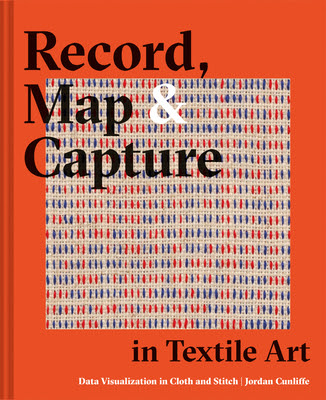
Weekend Review: Record, Map & Capture


Record, Map & Capture / Jordan Cunliffe
London: Batsford, c2022
128 p.


I recently checked out this title from my library since the concept really interested me, and I've also seen some of Jordan Cunliffe's work on Instagram. It's full of cerebral content - really conceptual work here. When she talks about textile art, she is talking about hand stitch almost exclusively, and how to 'write' onto fabric with thread. 

It starts with a solid intro by the author going over the ideas in the book and giving some background.  Then the book is broken up into 3 main chapters, with a set of extra resources at the end to use for further idea development (some graph papers, and charts of morse code and binary code). 

She starts with Data Visualization, showing examples of visual data as in the Bayeux Tapestry, and a more conceptual record of sleep patterns. She then moves into four artist profiles and provides two project ideas for this area. I found this use of data to create a textile work fascinating, but not very aesthetically appealing - it's very raw data, with a stitch representing one specific day/sleep/piece of data. Quite graphically strong though. 

The next section is about Steganography, basically hiding data in plain sight. This was my favourite section, as I could see it being used in so many ways. It reminded me a little of some of the ideas in Thomas Knauer's Quilt Out Loud which I reviewed last year. Here Cunliffe profiles 3 artists, and shows an example of a quilt made by an English WWII POW in Germany - he used Morse Code in a border of his quilt to spell out rude statements about Hitler, which I loved. In this section there is a focus on codes, including both Morse code and binary code. She shows some examples of her own work in which coloured beads are used to stand in for letters of the alphabet; she stitches up important documents, following their formatting but substituting her own colours for letters - so we can't read them but we can tell they say something. This appeals to me as I also love asemic writing in textiles. There is one project idea shared in this section. 

The final section focuses on Algorithms. She discusses Ada Lovelace, shares maps, 4 artist profiles, and two project ideas in this part. Here again the projects shown are graphics focused; whether just straight stitches, with each representing one bit of data, or a little more complex, the concept drives the piece. 

There is a lot of info here, lots to inspire and get you started making visual representations of data that matters to you. There are resources and links to follow and many artists to explore further. I liked this but I did find that the style of artworks shown here didn't really connect with me. I like a little more colour and vim and shape, while these pieces are centred on both line and white space. It's not my own aesthetic, but I can see taking some of the ideas and using them in work in my own style. Well worth reading in any case!