Showing posts with label embroidery. Show all posts

Sunday, September 13, 2026

Weekend Review: Creative Stitches for Contemporary Embroidery, Vol. 2


Creative Stitches for Contemporary Embroidery, Vol. 2 /Sharon Boggon
Lafayette, CA: C&T Publishing, c2026.
192 p.

This book was recently published and I was lucky to be able to read it right away. It's just a gorgeous and useful as Volume 1 by the same author! 

And all the things I said about Volume 1 when I reviewed it in 2021 apply here as well -- this is a great resource, a clearly photographed guide to 114 stitches (in addition to the 120 in the original) with clear instruction on how to make them, use them, alter them, and so on. Lots of wonderful examples of projects using these stitches in combination, and ways to add to them with unusual threads or objects like beads or textile ephemera. 

I enjoyed the ideas shared here, and I also like the way that this book is published in exactly the same format as the last one - they make a great matched set. The book is a usable size, with easily read photos, and is bright and glossy but also flops open easily so that you can leave it open at a page that you're trying out stitches from and it won't constantly close itself. Thoughtful! 

Anyhow, not much to add to this except to say check it out if you can, it is a super resource for any stitcher. 

Sunday, September 6, 2026

Weekend Review: The Embroidery of Mexico

The Embroidery of Mexico / Gimena Romero
Tunbridge Wells, UK: Search Press, 2026.
192 p.

I am back to regular blogging & to start off another year of Weekend Reviews I am sharing this amazing book on the embroidery of Mexico. This is a translation of a book by Gimena Romero, a Mexican textile artist & researcher. Her connection to her material makes every page sing -- such a cultural journey is shared here, alongside multiple stitches. I loved it! 

The photography is also stunning. Rich, bright, lots of close-up images of both the front and back of stitched pieces to inspire & instruct. (Photos by Pedro Aragon). 

The book includes a section of instructions on tools, transfer methods, stitch technique etc, also illustrated. And then Romero takes the reader on a journey around Mexico, covering eight traditional & modern styles of stitching. She shares the region, the parameters of each style & how to create something in that style. From more familiar kinds of Mexican embroidery to a tradition of stitching with hair, and modern street style, or her own recognizable stitching, she covers a lot. It's fascinating - where these traditional styles came from & how they were maintained, the language of stitching which is tied to the location and Indigenous language, the kinds of threads, colours, patterns- there is so much variety. She also includes 8 pages of templates of motifs you can trace & use. 

This is a beautiful & unique book, perfect for a coffee table read or some actual stitching inspo. I would say that beginners might not find this the best starter book as it contains a lot & assumes a bit of familiarity but for visual inspiration & cultural exploration it can't be beat. Loved this one, highly Recommended!


Sunday, May 24, 2026

Weekend Review: Seasonal Flower Embroidery

Seasonal Flower Embroidery / Kazuko Aoki
trans. from the Japanese by Alison Markham Powell
Boulder, CO: Roost Books, c2022.
112 p.


 I recently bought this lovely little book - I really enjoy Japanese aesthetics, and this embroidery book was delightful. One of a series of books by author Kazuko Aoki, this one features florals, inspired by a local Tokyo flower shop. It is quirky, though, with a few new ideas in it that delight me. She stitches a variety of blooms over 25 projects, and some in a more traditional, expected context, like hoop art or embellishment on clothing or housewares. But there was one project in particular that appealed. She embroiders a flower, then cuts it out of the fabric and glues a wire on the back to make it a stand alone piece — even covering the bottom of the wire with 2 paper circles cut from old books (as seen on the cover). I loved this! I really want to try it out, it's so beautiful! 


She also creates patches and pins, purses, gift tags, totes and more. I was really taken with the way she moves embroidery off the fabric and into 3D settings with her pins and display florals. But each of the motifs are beautiful. The book is laid out nicely, organized by the four seasons, with three kinds of flowers represented in each season. The patterns are clear, well explained, and illustrated with beautiful large photos. Then there are the projects - each of these also has robust instructions and large example photos which are pleasingly displayed. It's a treat to look at, even if you don't make anything! 


This is a great book, and it makes me want to pick up all of her other books now — she has a lovely style and I enjoyed the creative use of embroidery in unique projects. Definitely work searching this one out if you can! 

Sunday, May 17, 2026

Weekend Review: The Atlas of World Embroidery


The Atlas of World Embroidery / Gillian Vogelsang-Eastwood
Princeton, NJ: Princeton UP, c2026.
400 p.

I was lucky to come across this large and expensive book through my library system. It's quite big, full of 300 colour illustrations, and gives a great overview of embroidery from around the world. That is both its strength and weakness - because it covers so much, there is of necessity just a few pages on each style and region. But it gives a great sense of what's out there, and what you may be interested in then researching further. 

I thought it was an enjoyable one to flip through, and with so many images to examine that it was creatively satisfying. I flipped first to Ukraine to see what she'd included, and of course because there are only a couple of pages she could only touch on the basics. But this was in a chapter on Eastern Europe, with other, similar countries covered as well, so you could see the fine differences between countries. But there are so many regional differences with one country as well! 

This book made me hungry to explore more into areas I wasn't as familiar with, and the illustrations just piqued my interest in wanting to know more. I'll have to look up other histories that cover just one style to get more in-depth. This book, however, introduced me to a ton of styles. 

I liked it, found it absorbing, but not sure I'd spend the $60 price tag on it for my own collection - it's more of a browsing kind of book for me. Thank goodness for the public library! 

Sunday, May 10, 2026

Weekend Review: Embroidered Interiors


Embroidered Interiors / Penny Dowdell 
Stash Books, c2026.
160 p.

This is a fabulous new embroidery book, with a distinctive style and many new tricks for the embroiderer! I wasn't familiar with Dowdell's work before I picked up this book but am very impressed by it. So much colour and detail and lots of full coverage work that feels lush and complicated. She also uses extras like attached items or cutouts with images behind the holes cut into the working fabric. There are many cool ideas here that I haven't seen elsewhere, and she makes it seem easy. 

This is a project book, with a range of patterns provided, with instructions for each step, threads and stitches given, and all the extras explained (like adding coloured plastic for a stained glass effect). The patterns and guides are very clear, and include all sorts of interiors, from bedrooms to libraries, conservatories and dining rooms like the cover. I am impressed with the style of stitching and the complete instruction given. Anyone could learn this technique by following this book. There are also cute additions of sleeping cats and dogs in some of the scenes which could be added anywhere, really. An interesting element is how she shows that an entire 'set' can be stitched, or you could do a closeup of just part of one of the patterns if you want a bit more of an up-close view. Because of this, there are so many options to stitch from this book. 

I thought this was a wonderful book, very generous in the amount of information and guidance given. The style feels a little different from what I usually see, and is quite inspiring. I do love the cozy vibes! There is a stitch guide included, but she uses just a handful of stitches, so beginners could learn those and then tackle some of these complicated looking pieces which are just made step by step.  

This one is a hit, in my opinion. Just a little different, full of useful patterns, info and encouragement, and so cute. 


Sunday, May 3, 2026

Weekend Review: Garden of Stitches


Garden of Stitches / Mary Engelbreit
Kansas City, MO: Andrews McMeel, c2026.
160 p.

I am featuring some enjoyable new embroidery books this month, beginning with one by the fabulous Mary Engelbreit. I found this one thanks to the library system, and loved it. Of course, I've always liked Mary Engelbreit's style, which helps: this book is so her! 

It's a series of embroidery projects, floral themed for the most part. You know I was going to love the one on the cover! There are 30 projects, starting with pretty simple ones and moving forward in difficulty as you go through the book. The final patterns include her distinctive lettering, and I think it works really well in stitch. 

Each design has a pattern and a guide to the colours and stitches used for each element. There are a lot of line stitches, which are great for beginners, with not too much difficulty and a nice result. She also introduces the idea of shading some of the shapes on the embroidery with fabric markers before stitching, as seen on the cover image. This cuts down on full coverage embroidery while giving more depth to the images. It's a great idea that I think artistic people will enjoy, especially if they are new to embroidery and want to make a quick project. Also, this isn't just hoop art. There are examples of stitching onto jackets, hats, or pillows, for inspiration on how to use these designs (or parts of them) in your own way.


As noted, I got this one through the library, but I need to get myself a copy as there wasn't enough time to try some of these cool projects! It's a cheerful, colourful collection by an artist I admire for her art style and for herself too. Looking forward to owning this one. 


Friday, February 27, 2026

National Embroidery Month: Nostalgia is not a Strategy


At the beginning of this month, I mentioned that I had begun an embroidery based on inspiration from the speech given by our Prime Minister, Mark Carney, at the World Economic Forum in Davos in January. This was a speech that had immediate impact, but for me it also influenced an embroidery idea.

A phrase from this speech struck me as soon as I heard it: Nostalgia is not a strategy. Now, in context, the PM was referring to the state of the world and focusing on politics the way they are now, not as we want them to be. I agree with this! But it also immediately had shades of other meaning for me, applied to other contexts. As general life advice, this seems solid! And in light of tradwives trying to claim embroidery for themselves when stitching has always been, and very visibly so, a protest medium -- I thought this was a perfect candidate for a stitched piece. 

So I created a nostalgic looking floral spray, choosing a more nostalgic colour scheme as well. The irony appealed to me. It was a fairly quick project, though would have been quicker if I hadn't kept putting it down for days! 

I used Canva to design my original sketch, and then traced it onto my fabric. I like to use thrifted linen napkins to stitch on, as the quality is good and they are usually about the right size for small projects. That's what I'm using here. But because it was a lighter weight, I also put a layer of lightweight cotton behind it to add some structure and hide any carried threads. 

I used my favourite stem stitch (2 strand) for the word Nostalgia and the black lines around the text. I used 2 strand whipped back stitch for the rest of the printed words. The darker leaves were fishbone stitch, the bright ones satin stitch, stems were stem stitch, all 2 strand. The outlines of the brighter leaves were one strand stem stitch. As for the flowers, they were long and short stitch, with satin stitch yellow centres on the small purple flowers and french knots for the larger flowers. I just chose colours I liked, and didn't really keep track. 


I will likely mount this in a hoop as wall art, as I feel like that meets the nostalgia factor of this piece. But I will have to find one and paint it black first. I usually use my plastic hoops for stitching so don't have a wooden one lying around! 

In any case, I really enjoyed stitching this quick project and am so pleased that I actually started something timely while I was thinking of it! And that I pushed myself a little to finish it before National Embroidery Month ended! I hope you enjoy it too. If you want to stitch this one yourself, here is the pattern I made with the help of Canva -- I shifted the small sentence over a bit to the left when I traced it, fyi. 


Sunday, February 22, 2026

Weekend Review: The Dream Stitcher

The Dream Stitcher / Deborah Gaal
Anchor House Press, c2018
295 p.


This was a random discovery for me, via my library, and a great find. It's a novel that moves between the USA in 2008, and WWII Poland, following a family line of women. It starts out rather fantastical, and has elements of magic throughout, particularly in regards to embroidery. But it also has realistic historical content and strong characters.

Goldye is the titular Dream Stitcher: in Poland she discovers an uncanny skill at embroidery early on (readers will know why). She's taken in by Kaminski Fabrics, and stitches magical wedding dresses for Christian brides. When the Germans come, Mr. Kaminski claims her as an Aryan niece from France, and Goldye changes her name to Anna to survive. But she is still in love with her Jewish resistance fighter, and uses her magical embroidery to fight in her own way. She's so good that a German officer takes interest in her, and requires her to accompany him to France to interpret the mystical imagery of the Bayeux Tapestry, which the Nazis are convinced tells of their victory. 

In 2008, we meet Maude, recently widowed and in financial straits. She has to take her mother out of the home she's been in, too expensive to continue it. When she moves her mother Bea home, she brings along a large recreation of the Bayeux Tapestry that the nurses say she stitched while there, even though Maude has never known her mother to sew anything at all. Maude's pregnant daughter also moves home, and they try to understand the family secrets that start leaking out, especially due to the large tapestry Maude has hung in the living room. 

I thought this was a fascinating read. It melds history, fantasy, mystery and some thriller-y bits too. Plus there is a lot about the magical power to stitch reality that Goldye holds, and what it can and can't accomplish. There are a couple of troubling scenes of sexual violence, during the war, readers should be aware. It can be hard to read, but it's all disturbingly real. The historical elements are strong and the WWII sections are compelling. 

When we hit the contemporary chapters, it is fascinating to feel the difference in narrative tone. Maude is flippant and childish at times, and the writing reflects this. It's like the whole story turns into Maude's story with a minute adjustment to tone. I thought it was really interesting! Maude's story slowly begins to link into Goldye's but what I thought was coming was not what was finally revealed. What a great build up to the conclusion, it surprised me. 

This was an unusual read, unexpected and memorable. I'm still thinking about it. The embroidery was a key part to the book, and makes me want to go see the Bayeux Tapestry - it's in England starting this fall, at the British Museum, for the first time in nearly 1000 years. That would be fascinating. 

But the characters and the creative storytelling are also fresh and engaging here. I am so glad I stumbled across this book. 

Sunday, February 15, 2026

Weekend Review: Expressive Embroidery

Expressive Embroidery / Chloe Amy Avery
Ramsbury, UK: Crowood Press, c2025.
144 p.


This was a fresh, interesting read! It's not about patterns, it's about learning the basics and then using stitch as expression of your own artistic outlook. Written by an artist, it starts from the design side of things rather than the technical, and it really is what is says -- all about expression in stitch. 

The examples and projects in the book are all Avery's distinctive work, very painterly. The projects are near the end, and are all small projects intended to teach a technique or method, not really a "project" project. Anyone who has been embroidering for a while will have to relearn, as the specialty stitches and techniques of traditional embroidery aren't the point here. We see a lot of straight stitches, overlapping, using colour as the primary focus. The pieces can feel like sketches, with many of them showing different techniques for finishing, mounting etc. There is even a short bit on machine assisted embroidery (freehand, not computerized). 


But beginners will be interested too. The book contains some of the basics of fabrics, threads, tools and techniques -- there are a handful of standard stitches shown but there's also an emphasis on freestyling. Plus there are chapters on design and colour, from an artistic perspective, including how to notice light and take inspiration photos for your own creations. A reader who is wanting to create their own designs and/or their own distinctive style will find this book inspiring. 

Stitchers looking for a new perspective outside of traditional embroidery, especially those interested in stitching as an art form, will want to read this one. I found it really engaging. 


Sunday, February 8, 2026

Weekend Review: Marking Time

Marking Time with Fabric & Thread / Tommye McClure Scanlin
Atglen, PA: Schiffer, c2024.
198 p.


Renowned weaver Tommye McClure Scanlin has put together a book full of textile time-keeping projects. From her own lengthy practice of daily weaving, to others who crochet, knit, embroider or quilt diaries of daily data, this book talks about many different artists and projects. I did find it quite focused on weavers, since this is the author's specialty. I can't knit and can barely crochet so those were fascinating but not things I'd do myself either. The embroidery or quilt focused ones were the ones I could relate to a little more. 

Still, the concepts were interesting for anyone intrigued by data visualization. There were climate projects, use of codes like Morse or Braille, emotion trackers, daily reflections and more, all personalized to the artist's interests. And so many beautiful photos of all the things talked about. It's really a book to flip through slowly and investigate projects one by one. 

 McClure Scanlin starts off by introducing her own artistic practice and how she got involved in daily fibre diaries, with multiyear examples. She talks about the power of daily practice, and the book also includes some creative prompts. Then we meet a bunch of other artists interested in this idea, as well. I'd say that these were all established, professional artists, so they have the time and experience for projects like this. And the ability to share and exhibit many of their works also. So in that sense it is more aspirational for part-time or hobby craft artists; I didn't find anything grabbed me personally as something I could incorporate in my beginner work. 

Still, a great look at a popular way of creating work, and I really appreciated the blend of science and craft in many of these data visualization projects. It's a nice collection, one I appreciated being able to check out through my library. 


Sunday, February 1, 2026

Weekend Review: Birth Flower Embroidery


Birth Flower Embroidery / Amy L. Frazer
Beverly MA: Walter Foster Publishing, c2025.
128 p.

It's National Embroidery Month! I'm celebrating by trying to finish up at least one in-progress stitching project so that I can share it with you this month, and by sharing some of the embroidery books I've been reading lately. 

The first one is Birth Flower Embroidery - I found this in my library collection and thought I'd take a look. It's a great choice for the start of the year, as you can then plan ahead to stitch projects using someone's birthday flower -- unless their birthday is in January, then they will have to wait until next year ;) 

I thought this was a cute project book. The author gives an intro about the longish history of birth month flowers, and how there are at least two traditional ones for each month and sometimes even three. This means that there are 26 floral designs in the book, plus some extras at the end if you want to add some little bugs, worms or the like to your greenery! 

Each flower has a nice design, using different stitches, often in a spray so that the image is bigger and more visually interesting. Each one is shown completed, and then there is a chart of colours and stitches used for each design. She has included a glossary at the start of the book explaining her acronyms for the stitches she uses, and states that she is using DMC exclusively so those are the colour numbers included. (but you can find a conversion chart online fairly easily if you use another brand). 

The images are made for entry level stitchers - not too hard but challenging enough to keep you interested. Those newer to embroidery would learn some new stitches through the projects; while many are simple backstitch or satin, there are also a few more unusual stitches included. Instructions are pretty clear for each project. 

Projects are shown completed in the hoop and there aren't project instructions for other kinds of things, but there are suggestions as to how you might incorporate these patterns into other items than hoop art. 

The stitching examples and techniques are rough and modern; the author is an artist who uses stitch like painting, so the fine techniques of advanced embroidery aren't the goal here. They are designed to show the hand of the maker & to be fairly quick to stitch. 

The one quibble I had with it is her use of stem stitch. It's one of my favourite stitches for how fluid it can look, especially in lettering. I find her technique makes it visually choppy and it doesn't really look like a stem stitch in some projects, at least to me. But that's one small thing. Otherwise I thought this was a quick read, a creative guide to some ideas about personalizing embroidery projects, and I can see it being helpful in a variety of ways. 

Friday, June 6, 2025

Thrifted Threads, literally

On a recent thrift store round, I found some DMC perle cottons and rayon stranded thread, priced very affordably. I have a lot of regular cotton 6 stranded threads but I haven't actually seen DMC rayon thread before. So of course I bought as much as I could. It's so shiny! 

I'm looking forward to experimenting a bit and seeing how I like working with it. Maybe I will even use it on my next project, one I've designed for myself. Here's a sneak peek. 

I first designed the colour version in Canva, then made a line drawing from it that I will use for the pattern. The original can serve as colour inspiration. I'm planning on doing a lot of sampler style filling stitches according to whim, as I go. Once I start on it I will also start sharing my progress! Can't wait to show it to you :) 

Tuesday, April 29, 2025

Embroidered Simplicity 3684

I finally did it -- made my very own Vyshyvanka! A vyshyvanka is a Ukrainian embroidered blouse, but mine is not traditional. I found this lovely soft yellow cotton at the thrift store recently, and decided to use it to make Simplicity 3684. I chose View C as the one with the most "vyshyvanka" feel to the sleeve and I also liked the simple collar band.


I did all my regular adjustments to this blouse pattern - shortened above the waist by 1/2", shortened the sleeve (in this case I shortened both top and bottom parts of the sleeve by 1" each) and graded from 14 at neck to 16 at bust and 18 at hip. This usually does the trick for me. I do find the shoulders a bit wide, so may take those in at the shoulder seam a bit, would definitely remove some width if I make this again. And the fit is quite close, check those finished measurements before you choose your size. 

It went together quite smoothly. The sleeve/cuff used a continuous lap, which I am used to from Burda patterns, but I do have to stop and think hard about it every single time! I found that the most difficult part of the whole thing, the construction was pretty straightforward otherwise. And as it turns out, I don't have to unbutton the cuffs to slip this on, so it was unnecessary anyhow! There were also two fisheye darts on the back, but when I tried it on I didn't like the way the blouse sat with those darts, so unpicked them and pressed them out again. This fabric is pretty forgiving.

As for the embroidery: 

I tested out various stitches and thread weights on my scraps, to see what I liked best. This cotton is lightweight and translucent so I was concerned about shadowing from the threads on the back. I found a simple motif that didn't require heavy stitching, again because this fabric doesn't have the weight to support lots of stitching. 

I ended up using the rhomb pattern, which can symbolize nature's rebirth, abundance, fertility, etc. From what I could find, this is often used in men's traditional designs, but I thought it would work nicely in my modern, non-traditional project. I used single, small motifs on the cuffs, button placket and collar, but created larger double rhombs for the sleeve decoration. All of these except for the sleeve are interfaced, so the stitching is supported well. I will keep my eye on the sleeve and see how it holds up. 

I chose three threads from my stash - all DMC. White, light blue (827) and a darker blue (996). I used three strands of each and the motifs were all done with buttonhole stitch and a few straight stitches, while the white was all straight stitch. I considered french knots but when I was testing I realized they would be too fragile for regular wearing. Using buttonhole stitch means there isn't much thread on the back, either, which is perfect. The stitching, after the testing and tracing, took me about 4-5 hours to complete. Not too bad, but these are simple motifs so it wasn't as lengthy. I don't know how to cross-stitch so went very basic here, also I know I am a slow stitcher so didn't want something really complicated for a first try. 


Buttons were a lucky match. I searched through a big box of shirt buttons that my sister gave me a few years ago, and found the perfect size and muted colour for this project. I wanted buttons that would blend in and not distract from the stitching. I think these worked really well. 


Well, after much dithering, I finally went ahead with a first simple Vyshyvanka project. I have a handful of other blouse patterns to try out and see if I like them for this purpose, but I had to start somewhere! This Simplicity pattern, which I put on my 2025 MakeNine list, was the one to begin with. Now that's 2 Make Nine projects completed for the year :) 


Sunday, March 30, 2025

Weekend Review: Colours in her Hands


Colours in her Hands / Alice Zorn
Calgary, AB: Freehand Books, c2024.
350 p.

This was an intriguing book that I liked for a number of reasons. There's embroidery, there's Montreal, dance, colour and family drama. 

Mina is close to 30 - she lives independently although she has Down's Syndrome. Her slightly older brother Bruno is her legal caretaker, and this responsibility is something he takes very seriously, making sure he is always available when Mina (or her social workers) have an issue - which is often. His girlfriend Gabriela loves Mina, but Bruno's refusal to have a child because of his responsibilities is driving them apart at the beginning of the book. After Gabriela leaves him, he meets Iris, a clothing designer who had come across Mina in a park and discovered her artistic talents. 

Mina "knits" - it's really embroidery, but Mina calls it knitting. It seems to come naturally to her; the colours speak to her and she just knows what to put together. It's an emotional connection. When Iris discovers that Mina has bags full of her embroideries, she sees fame and fortune ahead -- this outsider textile artist needs to be known. But this goal seems to exclude her telling Bruno or even Mina herself about her plans. 

These stories swirl around each other, and include Bruno's work as a prop designer for a small theatre as well as some other side stories. There are questions of how well two people know each other, what kinds of things are revealed or kept secret, and of course ethical questions arise around art and ownership and who has the right to share things. 

The book is fascinating, and Mina's character is strong and compelling (the author says she was inspired by her own sister-in-law). But I did find there was a lot of extra stuff going on that made the book maybe a bit longer than needed. And the ending was a bit off for me; there was a character introduced near the end who had a problematic relationship with Mina and that was never resolved. 

But I did find this so different from anything I've read lately, and it was full of art and music and people who live intense lives and care about things. I'm not sure I really liked any of the characters much, but I enjoyed a lot about this story, and loved the descriptions of Mina and her "colours" as well as Iris' sewing. Other stitchers will understand! 


Sunday, March 23, 2025

Weekend Review: Connecting with Nature

Connecting with Nature / Tilly Rose
Tunbridge Wells, UK: Search Press, c2025.
128 p.

This book is a little different from the previous stitching books I've mentioned this month. It's more of a mixed media approach to craft. Tilly Rose is an artist from the UK, and this book reflects what I think of as the English aesthetic when it comes to stitching. Lots of ephemera and things in states of what looks like disrepair - a shabby chic effect overall. 

This particular book is organized around the seasons. She starts out with some basics on botanical dyes and paints (including how to forage responsibly), and shares tips on weaving and slow stitching. Then the book moves into chapters on Winter, Spring, Summer and Fall. There are 2 or 3 projects in each chapter, featuring varied techniques. 


From the aforementioned botanical dyes to cyanotypes, flower pressing, slow stitching, floral mandalas, or weaving with natural materials, each one takes a little bit of a different approach to creating nature based projects. Because you're using materials like this, a lot of the projects will be ephemeral ones. Although she does give advice on how to get the bugs out of the sticks or reeds you might want to use... 


There are some interesting ideas here, even if this book as a whole is a little too earth mother for my own aesthetic purposes. I liked the dyeing chapter, some new to me bits there, and the stitched blessing is a lovely touch, even if I would leave off the attached twigs and bits myself. 

You might find this a nice one to look through, especially if you enjoy bringing nature and all types of flora into your work. But if you're looking for anything sleek and modern, this won't do it for you. 


Sunday, March 16, 2025

Weekend Review: Journal With Thread


Journal with Thread / Jessie Chorley
Pynes Hill, Exeter, UK: David & Charles, c2024.
111 p.


I love embroidery, and I love journaling - so I really couldn't resist this book when it appeared in my local library! It's a collection of motifs (iron-on included in the back of the book though of course you can also just trace any of them) plus some design suggestions. All in the service of creating a fabric journal with a visual record of your days. (lots of interior photos on her blog as well!)

The book opens with an overview of what exactly a fabric journal is, and some ideas about inspiration, tools and materials, sketching, appliqué, a thread and stitch guide and of course motifs to share. But by page 40 she's jumping right in to the making of a journal. 


The main part of the book involves how to create your own fabric journal, whether that's all completely from scratch or by applying stitched panels to a premade fabric book. She follows the round of the seasons for her example work but of course you can create any design you want. 

She goes into detail for each page of the book, with instruction and photo examples (lots of big clear photos). She shares Front Cover/Inside Front Cover, Spring, Summer, Autumn and Winter pages, and also the Inside Back Cover/Back Cover layout. All of this specific, hands-on instruction takes up 50 pages. 

The book finishes with some additional templates and further ideas, as well as a list of resources and DMC colour codes. And the iron-on transfers are all attached in the back of the book too. 

I thought this was an interesting concept, and really liked the straightforward instructions on creating a book from fabric. I'm not sure I'd have the same visual style if I made one; I probably wouldn't use many of these motifs for my own version. But I really like the idea of creating a book like this, and I enjoyed seeing how she uses extra items beyond just threads to create her imagery. She'll sew on bits of lace or cloth, or use buttons or Suffolk Puffs as ornamentation. She even has some snaps and tiny jingle bells in her wintery scenes. Lots of fun to look through. It's the English joy in imperfection that shows through here, and I did feel it worked in this instance. Glad I read it! 

Sunday, March 9, 2025

Weekend Review: The Intentional Thread


The Intentional Thread / Susan Brandeis
Atglen, PA: Schiffer, c2019.
224 p. 

This is a wonderful book! If you want to learn how to use stitches like paint or pencils, this is the book for you. Brandeis covers many specific stitches, including machine stitching, but it's not just a collection of stitch guides. In fact it's not really that at all. 

This is a design book, where the stitches are shown in many variations, with many ideas how to create and use them in the service of composition and design principles. Not only does it show the stitch and its variations but there is also a "Try This!" addition to each one to help you learn and practice for yourself. 

Colour Wheel in stitch

There are tons of beautiful photos to teach and to inspire, and the book's design truly adds to its value. Brandeis talks about the basics like thread and base fabric choices - the colour wheel above is stitched on silk noil, and I love the texture of it. 

There are discussions of pictorial work, portraiture, abstracts, or my own favourite, text. I loved the text chapter, there were so many ideas on how to use your stitches to incorporate words into your pieces. Lots of different choices and variations on text, and I want to try them all. From strong visuals using one very readable word, to delicate asemic writing, she covers a range of concepts. 

This carries over to the other chapters as well. There is so much to explore in this book, it's one that you would be able to dip into over and over and keep trying new things. There is also a nice list of resources included at the end. Definitely one for you, if you have any desire to increase your stitching skills, your artful eye, or your ability to say something clearly in your artwork. I'll be looking for my own copy for sure. Highly recommended.


Friday, March 7, 2025

A Stitched Portrait

One more crafty item I have been working on recently is a stitching project inspired by an online class I took in January. TextileArtist.org is a group I often check out, even if I can't afford to join their actual Stitch Club. They have interesting features on textile artists from around the world, and once a year they often offer a free, short class as a teaser for their full educational program. This January it was Stitched Portraits with Susie Vickery. It was a fascinating class, and I really enjoyed it.


At the beginning of February I finally had time to try it out myself, and used a photo of my Mom to see how I could work out this process. It was harder than it looked! I followed the steps and gave it my best shot - for the first try ever it's not bad, although I can see a bunch of things about it that I would change on a second attempt. Mostly the length and density of stitches. I really enjoyed it though, and felt it was a great learning experience.


I would choose a less busy photo, as well, since I was editing as I was creating the pattern. It's recommended that the image is fairly small (6" max) so that it's not overwhelming, and I agree that it made it much easier to use a small pattern to try this out. As usual, I like bright colours so I chose a fun background from my stash and enjoyed this one. I will definitely try this again!


Sunday, March 2, 2025

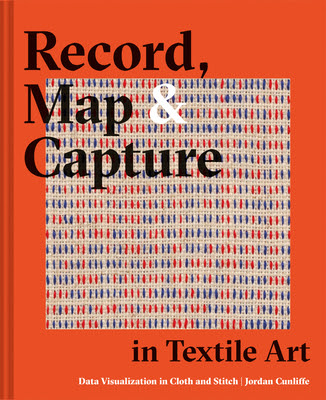
Weekend Review: Record, Map & Capture


Record, Map & Capture / Jordan Cunliffe
London: Batsford, c2022
128 p.


I recently checked out this title from my library since the concept really interested me, and I've also seen some of Jordan Cunliffe's work on Instagram. It's full of cerebral content - really conceptual work here. When she talks about textile art, she is talking about hand stitch almost exclusively, and how to 'write' onto fabric with thread. 

It starts with a solid intro by the author going over the ideas in the book and giving some background.  Then the book is broken up into 3 main chapters, with a set of extra resources at the end to use for further idea development (some graph papers, and charts of morse code and binary code). 

She starts with Data Visualization, showing examples of visual data as in the Bayeux Tapestry, and a more conceptual record of sleep patterns. She then moves into four artist profiles and provides two project ideas for this area. I found this use of data to create a textile work fascinating, but not very aesthetically appealing - it's very raw data, with a stitch representing one specific day/sleep/piece of data. Quite graphically strong though. 

The next section is about Steganography, basically hiding data in plain sight. This was my favourite section, as I could see it being used in so many ways. It reminded me a little of some of the ideas in Thomas Knauer's Quilt Out Loud which I reviewed last year. Here Cunliffe profiles 3 artists, and shows an example of a quilt made by an English WWII POW in Germany - he used Morse Code in a border of his quilt to spell out rude statements about Hitler, which I loved. In this section there is a focus on codes, including both Morse code and binary code. She shows some examples of her own work in which coloured beads are used to stand in for letters of the alphabet; she stitches up important documents, following their formatting but substituting her own colours for letters - so we can't read them but we can tell they say something. This appeals to me as I also love asemic writing in textiles. There is one project idea shared in this section. 

The final section focuses on Algorithms. She discusses Ada Lovelace, shares maps, 4 artist profiles, and two project ideas in this part. Here again the projects shown are graphics focused; whether just straight stitches, with each representing one bit of data, or a little more complex, the concept drives the piece. 

There is a lot of info here, lots to inspire and get you started making visual representations of data that matters to you. There are resources and links to follow and many artists to explore further. I liked this but I did find that the style of artworks shown here didn't really connect with me. I like a little more colour and vim and shape, while these pieces are centred on both line and white space. It's not my own aesthetic, but I can see taking some of the ideas and using them in work in my own style. Well worth reading in any case! 

Sunday, February 2, 2025

Weekend Review: The Art of Embroidery Design

The Art of Embroidery Design / Christi  Johnson
Storey, c2025.
200 p.


February brings us Embroidery Month, and so I'm going to share some stitching books this month. Starting with this excellent new release! I can't really say much about it, however, as it was one I reviewed for a professional journal. You can read my review for Library Journal here

Word count is limited in my professional reviews, so I did want to just add that not only did Johnson illustrate the cover, but many pieces are shared inside as well. And traditional needlework is shown in context also. This is a fantastic book that any stitcher who wants to start creating their own meaningful work will want to own. Great design principles, encouragement, and inspiration. Five stars!