The patchwork vest workshop I mentioned last week was so much fun!
There were 10 of us there, stitching together for 6 hours while chatting and enjoying. We mostly finished our vests.
The patchwork vest workshop I mentioned last week was so much fun!
There were 10 of us there, stitching together for 6 hours while chatting and enjoying. We mostly finished our vests.
![]() |
| Reclaimed Quilts / Kathleen McVeigh & Dale Donaldson Cpncord, CA: Stash Books, c2024. 128 p. |
This book was a lot of fun to look through, even if I might not be able to carry off some of these extreme quilted looks myself. Their focus is to upcycle damaged textiles, mainly quilts and quilt tops, to make into garments. I have to say, my favourite piece in the book is the dress front and centre on the cover, but that's my taste -- you might find something else here that speaks to you.
This one is really about reusing existing quilts (and little projects to use up the scraps) not so much quilting your own yardage. So you have to want to go all in on the quilt look! The book includes instructions on how to find, clean and care for vintage textiles (and talks about when you should probably NOT cut up a quilt), as well as including basic and specialty construction tips for quilted fabrics, such as seam finishes, binding, pockets and so on.
There are 8 garment patterns and then a few smaller things like totes and pouches, ways to use the leftovers once you've cut out your garment pieces. I think it's a nice way to lay it out, with inspiration and practical guidance side-by-side. Also the sustainability piece is there at all times.
There are many photos, mainly of the authors and some of their fellow young hipster friends, all modelling the various pieces. As I noted, not all of these items are to my own personal taste, but I might make a couple of them, like the dress or tote, if I had the right textile. In any case, those who do have an interest in this aesthetic will find this a cheerful, helpful book. I enjoyed it even if I don't end up making anything from it. So colourful and cheerful to look through.
![]() |
| Sewing Quilted Patchwork Jackets / Rae Cumbie & Carrie Emerson Mount Joy, PA: Landauer, c2024. 184 p. |
It's all about, obviously, quilted patchwork jackets. The subtitle is "Four approaches, Ten Distinctive Designs, Two Downloadable Patterns". This is slightly misleading, as the book is based on the Opus Coat pattern by Fit for Art, and the two patterns are the adult and children's sizes -- available for download but also included in the back of the book as photocopiable patterns. There are four approaches though: whole cloth, patchworked, collaged, or reworking an existing quilt. And there are 10 different projects here, which can look very distinct from one another thanks to small details, aside from fabric choices of course.
The pattern has options for a front band closure, a collar, or even a vest version (all shown on the front). You can adjust those to create a wide contrast front band, extend the jacket into a duster, add applique, pockets or linings, and choose from buttonholes, button loops or snaps as a closure. Lots of variety shown thanks to the many projects included.
I was intrigued by a couple of the projects in particular, but each one is well thought out and has clear images and instructions. I really appreciated that there are tips throughout for garment sewists who aren't quilters, but also for quilters who aren't garment sewists, about the particular differences that each might need to be aware of.
It starts with sewing tips, ideas for design, and construction and finishing steps to be aware of. Then it moves into the projects, each of which has large photos for each step and lots of instruction. Like I mentioned earlier, there is a nice variety in the finished projects -- she uses different colourways to show how the jacket can look quite distinct, from jewel tones to Morris prints to denim and orphan quilt blocks. They all give quite a different vibe.
I think this is a great resource for anyone interested in making a trendy quilted coat from scratch; there is only one (the duster coat) that uses a premade quilt. Well organized, lots of inspiring images and tons of practical information. I was impressed.
Last week I was fortunate enough to take in Quilt Canada for a day, seeing as how it was held only a couple of hours away! I had fun going down as part of a bus trip with a local quilt guild, which made it much easier - no driving the 401, just hanging out on a bus and relaxing with a bunch of other quilt people :)
It was a great show, lots of exhibits from different artists and guilds alongside the National Juried show. It took me over 2 hours just to go through the exhibits, before I could even think of visiting the vendors. I was pleased to see that there was an exhibit by Canadian SAQA members, a national show called Renewal.
Here are just a few of my faves that I saw there!
![]() |
| Best of Show: After the Fires by Wanda Lumsden |
![]() |
| Winter Solstice by Susan Selby (loved this one!) |
Of course I couldn't resist a little treat for myself as well -- I picked up some LDH Scalloped Pinking Shears. I had been eyeing them before going, and when I tried them out I decided to just go for it! They are so pretty.
![]() |
| Quilt Out Loud / Thomas Knauer Concord, CA: C&T, c2023 144 p. |
It was an enjoyable afternoon & the subject was not too intimidating. It's basically a fused applique style, with the visual effect of beach glass (although as people at the class notes, you could adapt this technique for other effects as well).
![]() |
| Stitch Your Story / Sarah Fielke Louisville, CO: Lucky Spool, c2019. 144 p. |
I enjoyed the variety in this book. It's a little longer than the others, and has some interesting projects included. The first three sections are based on gridwork; the letters are put together in squares, half-square triangles, and a couple of other more angular blocks too, depending on the letter and style. It's an interesting way to think of creating text, and the three options show how different the choices are using much the same technique. Section 5 is kind of a follow-on to these options, being an improv piecing technique that is freer than the grids but gives a similar effect.
Section 4 discusses needle-turn applique, which allows you to have more rounded letters and a cursive effect. It's definitely something that interests me, but I think you have to like applique to use this more than for just a few letters! I'm not so great at it but perhaps could improve with practice. But the best idea, for me anyhow, was the use of bias tape to make a cursive word across a background. She suggests prepared fusible bias tape for the easiest use, but of course you can also make your own and stick it down yourself.
I really like this style of lettering. Because it's bias, it's flexible and able to be arranged into flowing shapes. In the section featuring bias, the instructions are clear, with diagrams, to show you the best places to fold, overlap, or otherwise shape your letters in bias tape. You can use purchased bias tape or of course use your own in any print or colour you want. I have varied sizes of bias tape makers so could easily give this one a go. Since I love handwriting and cursive, this technique jumps out at me as something I'd really like to try out.
All of the sections are clear in their instructions, and the photos in this book are bright and detailed. Plus there are diagrams and patterns so that you can incorporate these styles of lettering into your quilting easily. I also liked many of the projects in this book. They are not all simply lettering as the main or only element; there are beautiful backgrounds with lettering as one element that blends in nicely, as with the bias tape pillow. There is also some discussion of what words you might want to use and why -- a little bit about the concepts behind a project, which was interesting to think about as well.
If you're interested in these techniques and ideas, you can check out this book too, it's really good. Or, you can take Sarah Fielke's "Word Play" course on Craftsy, or her Improv Lettering class right on her website. I can see so many ways to add lettering to projects!
![]() |
| Word Play Quilts / Tonya Ricucci Bothell, WA : That Patchwork Place, c2010. 64 p. |
![]() |
| Quilt Talk / Sam Hunter Lafayette, CA: Stash Books, c2014. 144 p. |
![]() |
| Small Art Quilts: Explorations in Paint & Stitch / Deborah O'Hare Tunbridge Wells, UK: Search Press, c2018. 144 p. |
![]() |
| Art Quilts Made Easy / Susan Kruszynski Mount Joy, PA : Landauer Publishing, ©2022 144 p. |
![]() |
| Color, Thread & Free-Motion Quilting / Teri Lucas Lafayette, CA: C&T, c2020 95 p. |
I'm interested in learning more about art quilt techniques so sometimes I do pick up a few books to explore topics in this area. This is one I found via my library system; it looks at how using colour enhances a project. Instead of just quilting a project in invisible/matched thread, she examines how using color can be another design element in your quilt.
It's a fairly short book, but the instructional tone is clear and the book is well structured. She shares a colour wheel and talks about colour selection, but also includes lots of photos and examples. And, instead of relying on theory, there is also a large section in the book about making your own colour wheel samples, so you'll get practical experience with how colours work together. Using different colours of ground cloth, she suggests stitching up a bunch of colours (and weights) of thread to practice and see the results in actual stitching rather than just laying a thread across a fabric and trying to estimate the results you will get. I think this is very useful advice, and learning by doing is usually that way that works best for me.
I also appreciated a section on thread types and weights, why and when you might use them, and the proper needles to use for each -- there's even a handy chart to help you out.
What I found didn't work as well with this book was the 36 quilting designs mentioned on the cover. They are square samples at the back, hand drawn, and are all pretty standard designs that anyone who has looked into this area before will already be familiar with. So if you want to learn about colour and thread, there is a lot here, but if you are just looking for some new designs, try another title.
I also found the stitching in the samples to be very basic -- maybe that's an encouragement to those new to the practice, though, as they are not glistening finished pieces. They are clearly sample works made as references and are not attempting to be anything else. They are simple unfinished pieces that set an example to perfectionists that you must learn by doing. The goal here isn't perfect stitching, it is in the use of colour and how threads play differently with ground cloth. And that is shown very clearly.
Anyhow, if this is an area that you feel that you need to explore, this is a good title to check out. I learned some tips that were new to me and really appreciated the focus on hands-on exploration.
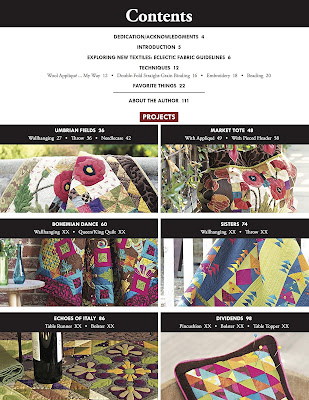
| The Art of Mixing Textiles in Quilts / Lynn Schmitt Lafayette, CA: C&T, c2018 111 p. |
This book is a great resource. The first section talks about the different non-quilting cotton fabrics that the author uses, like wool, silks, linen, or upholstery fabrics, among others. She goes over the best ways to use and combine these fabrics -- tips on seam pressing, stitching, interfacing/stabilizing, and so on. One good example of a basic tip is when sewing heavier fabrics like wool or upholstery weights, don't press the seams to one side. Press open to reduce bulk, and you can also grade seams. This is something garment sewists will probably know but it's a great tip for someone new to incorporating these fabrics.
I'm mostly interested in this topic because it seems to me that this book has lots of great ideas that can be used in garment sewing, especially these days as patchworked and quilted clothing is becoming a little more popular once again. And I feel like there is a lot of useful content here. Plus beautiful images, did I mention that already?
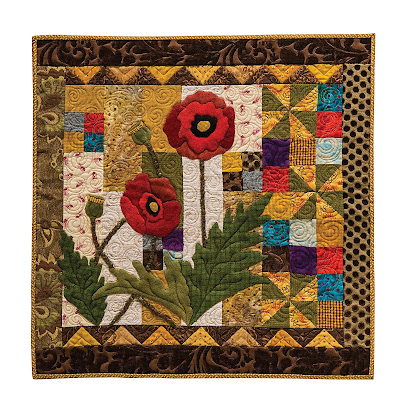
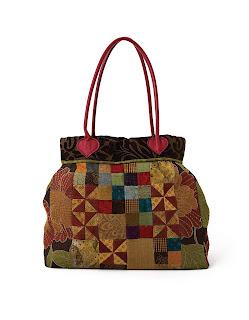
Her style of eclectic piecing as she calls it is really eye-catching, as is shown off with 14 projects here -- pillows, quilts and small projects which feature piecing, applique and some wonderful quilting designs too. One piece that uses both traditional blocks and more modern design is this beautiful little wall hanging. I love the combo of colours, techniques, and the overall finish.
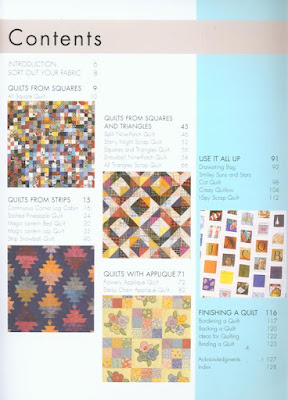
| Making Scrap Quilts to Use It Up! / Lynne Edwards Newton Abbot, Devon: David & Charles, c2003 128 p. |
One of the ways to sew more sustainably is to make sure you're using as much of your fabric as possible, and wasting very little of it. Making quilts has always been a traditional way of doing this. However, I'm not really a quilter, well, not a traditional one anyhow. So I don't end up using a lot of my scraps in this way.
But, I recently saw a book review on PatternReview for this book, Making Scrap Quilts to Use It Up by Lynne Edwards. The reviewer mentioned that along with quilts this book includes two other small projects, in particular, a bag that she was interested in.
It sounded so intriguing that I quickly requested this book on Interlibrary Loan and have had a chance to read through it over the last week or so. It is a good collection, with a variety of quilts (16 patterns) using small pieces, arranged either randomly or in set quilt patterns that give great visual effects. There are good photos and clear diagrams and instructions for the projects as well.
One of my favourite kind of quilts is the random scrap style, and the first one in this book is a massive postage stamp quilt -- all made of 1.5" squares. It's really appealing, the kind of scrap celebration I love. There is also a quillow pattern, I recall making a bunch of these for Christmas gifts many years ago!
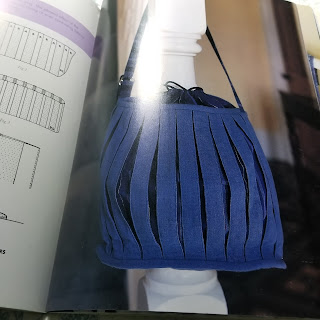
But as I am mainly a garment sewist, I have to agree with the original reviewer that the highlight of this book is the very unusual bag pattern. It's a pleated bucket bag style, with an interior drawstring closure. I haven't seen a style like this before, and there are examples both in solid fabric and in patchworked fabrics. I don't make many bags but this is such an interesting design that I'm eager to give it a try.
This book is out of print as far as I can tell, so you'll have to find it second hand or via your own local library if you are interested in investigating it as well.