Showing posts with label denim. Show all posts

Sunday, March 1, 2026

Weekend Review: Jean Genius


Jean Genius / Janelle Hanna
Skittledog, c2025.
160 p.


This interesting new book was one that showed up in my library. It's quite a clever one, with great aesthetics. If someone loves denim and has a lot of it, this is a look at the "slow denim" movement, exactly as the title says: repair, restyle, repurpose. 

The book begins with a bit of a history of denim, indigo, and the ecological footprint of a pair of jeans. So encouraging people to think more sustainably about their jeans. Then it moves on to know-how -- deconstructing jeans for maximal use, sewing tips for denim and so on. Next we have a section on repair (darning, patching, hemming), one on restyling (adding side seam inserts, making shorts or skirts), and then repurposing (bags, hats, slippers, patchwork). 

It's laid out in a clear manner, with tons of large photos of jeans, each finished project and all the steps. The instructions for each project include photos and step by step text, alongside a skill rating, how long the project is estimated to take, and the supplies needed (ie: a waistband from an old pair of jeans, certain amount of fabric etc). While some of the projects seem basic or common, there are options given even for easy ones, and lots of inspiration photos to get you going. 

The repurpose projects are a little different - while they are common accessories and household items, they have a fresh edge and the way the author combines varied colours and tones of denim is really attractive. The patchwork section is helpful with technique for a simple panel that can then be used for anything - pillows, throws, clothing. 

This is an attractive book, well put together, with enough to interest a casual reader as well as one ready to tackle that pile of old jeans. There is also a further resources section at the end with some books, websites and podcasts to follow up your reading. Although I personally don't have a lot of jeans (I hardly wear pants) I can see how this book could be useful to those who have tons to use up! Visually, it's really appealing and I enjoyed going through it. 


Sunday, September 21, 2025

Weekend Review: Denim: From Cowboys to Catwalks


Denim: From Cowboys to Catwalks / Graham Marsh, Paul Trynka & June Marsh
London: Aurum Press, c2002.
128 p.

This visual history lives up to that claim; it's oversized and full of photos, both modern and historical. Lots of info in the photo captions as well as a relatively condensed but interesting text. The only thing that wasn't clear at the outset was that this was a history of denim (primarily jeans) in the US only. It is  a history of denim in the US, with only a few mentions of styles across the pond here and there. 

However, as such it is detailed and comprehensive about the many ways that denim shaped fashion culture in the States, from Levi's rise in California while Lee was bigger elsewhere in the nation, to the use of denim by cowboys, miners, as work outfits of all kinds (even factory coveralls), to the rise of denim as a fashion fabric from Claire McCardell onward. It discusses the many brands that popped up besides the two biggies, and the denim mills that were heavily used, particularly Cone Denim, around since 1891.

In the fashion/catwalk sections, there is discussion of British and European designers who incorporated denim into their new lines. But most of the book does focus solely on the US and the adaptations and changes in the use of denim by American citizens, who took jeans and denim jackets etc. and made them their own, whether as workwear, sportswear, hippie bellbottoms, punk ripped jeans, or sexy designer jeans. As the author said, denim is the only style that was both culture and counterculture at the same time. 

I enjoyed this; from historical pictures to vintage advertisements, to fashion images, the illustrations make the book. There is a wide range, and I appreciated the inclusion of McCardell and some of her denim suits and fancy outfits, as well as the famed Pop-Over dress, in the midst of a very male oriented fashion history. I learned the differences between jean jacket designs - Levi's vs. Lee - and enjoyed examining some details of the sewing and design of various pieces over the years. 

It's a pretty short read in the end, but it somehow covers a lot! Really interesting, I enjoyed this examination of how denim and casual jeans culture shaped a lot of communal identity and fashion directions over the 20th century.  Visually appealing and full of tidbits to keep you reading. 

Sunday, April 20, 2025

Weekend Review: Unraveled


Unraveled / Maxine Bédat
Portfolio, c2021.
336 p.

Today's book is about fabric in a way, but really more about one specific garment made with one specific fabric -- it uses one pair of jeans as a way to travel through fashion's supply chain and follow a ubiquitous garment beginning to end to reveal so much about the fashion industry today. 

Since it is Fashion Revolution Week this week and also my local Trashion Week, I thought it was a perfect time to talk about this book. 

The author began as an entrepreneur in the fashion world, but realized fairly soon that her attempt to create a responsible brand was stifled by so many suppliers not knowing their own supply chain. So she pivoted to education and work on that end of things. In this book, she is educating readers on the worldwide production of fashion and all the steps in it that are not necessarily following the same regulations. 

From growing the cotton in Texas, to weaving and dyeing in China, to sewing in Bangladesh or Sri Lanka, then shipping from warehouses like Amazon ones in North America, all the way to a pair of jeans being discarded after just a few wears and ending up in landfill or shipped off to African second-hand markets. So many issues to discuss at each step! She does have an American perspective so her examples are grounded in the US, but much it is the same across the world. 

Each chapter takes on one of these steps and discusses the problems jeans can cause. From massive water use to grow monocrops of cotton, to the chemicals (most banned in North America) that are running into the water systems across China, to the terrible working conditions for mainly female seamstresses sewing your clothes (yes, all clothing is handsewn by someone), to demanding warehouse jobs with poor pay and outrageous expectations for employees, to the shopping habits of consumers who will toss something after a wear or two, to the conditions in landfills and the economic and environmental effects of massive piles of used clothing dumped into African markets, it's all here to read and learn. 

I found her style perhaps a touch dry at times, but overall very readable. She brings in personal stories to enlarge on the facts she is sharing (some of them quite shocking) and the central concept of following a pair of jeans along a production path is relatable to most people; she notes that American women own an average of 7 pairs of jeans. I don't really wear jeans, and only have some I thrifted a few years back for when I might need a pair -- but I can see the thousands of pairs out there! I thought this was a great way to make these ideas understandable to general readers. If you've been reading on this topic for a while, you will be familiar with the facts shared here. But it never hurts to get a new perspective, and this one might be a good choice to hand to someone interested in the ideas but who hasn't read everything yet. Jeans are kind of in your face fashion, and so this might hit home in a strong way. This one is worth checking out! 

Friday, March 4, 2022

Liesl & Co Advisor Circle Project One!


I announced earlier on that I'm a part of the Liesl & Co Advisors Circle for the year -- well, I've done my first project for their blog! You can find the post here.


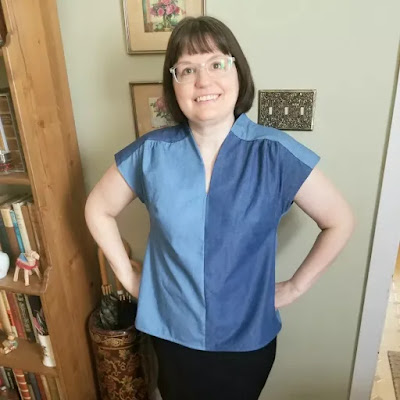
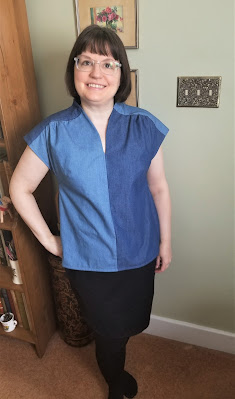
The idea for these projects is to take one or more of Liesl's patterns and adapt it in some way, or show another way to fabricate it. This time around the challenge was colour blocking. I had bought the Fira top when it was first released, and thought that this pattern would be a great option for colour blocking. Fortunately, Dyann from the Advisors Circle thought the same, so we did a joint post showing our versions.

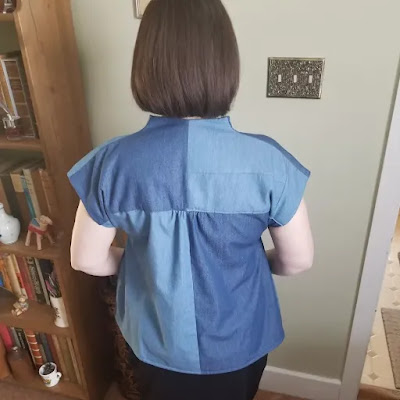
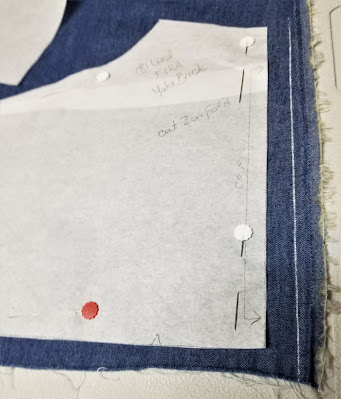
For mine, I divided up the original front pattern piece into two, remembering to add a seam allowance to the new centre front seam (I used 1/2" for ease of measuring). The front yokes are already separate, so I only had to divide the back yoke into two rather than cutting on a fold as well. The back of the top already has a centre seam so no problems there! 


I used some denim scraps from an earlier dress, which coincidentally happened to be Butterick 6567, a Lisette dress, one of the patterns that Liesl designed for Butterick in the past. That wasn't planned! But I had a fair bit of these lightweight denims and thought that the low contrast would be visually pleasing; I had used the contrast in the dress and liked it. 

The hardest thing about this top was just making sure I cut the pieces in the right orientation, so that I'd have the correct pattern of colours to put together. With such limited fabric, I measured more than twice before cutting once ;) 


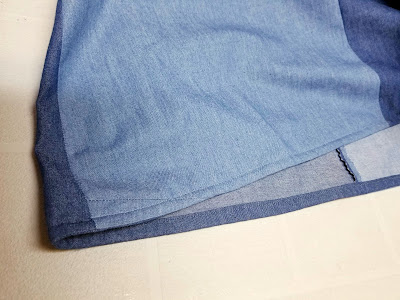
I used the darker fabric for the inner yoke since I had quite a bit more of that, and ended up using a strip of it as a hem facing as well, since I had to shorten the pattern quite a bit to fit onto my fabric. Thankfully I'm so short that it still worked, as long as I didn't turn up much of a hem, so 1/4" seam hem facing it was. 


This was a real puzzle to work on. Since I was quite low on larger pieces of the paler blue denim, I had to piece together remnants to get chunks large enough to cut the back yoke from and ended up having to also piece little corners of the front yoke and the lower back edge as well. Fortunately piecing looks great in denim, and also goes with the scrappy colour blocking feel, I think. 

I'm really happy with the top and found it a fun challenge to make. Aside from having to give it a press every time I want to wear it, it's great ;) The pattern itself is pretty simple, although the yoke construction can be a bit of a stumper for a minute. The inner yoke is sewn together with the body, then it's flipped to the outside and topstitched down on the outside. This isn't a way I've done a yoke before, so I had to think about it and play with my fabric a bit to get the hang of it. But I think it was worth it -- a fun top and one that used up some really nice remnant pieces. A win!


Wednesday, June 6, 2018

New Look 6936 in Denim Knit

As many of you know, last weekend was Pattern Review Weekend 2018, and it was held right here in my town of Stratford, Ontario. I was lucky enough to be one of the organizers this year and we had a wonderful time coming up with a program and fun activities for everyone to enjoy.

It was enormous fun and all the hard work paid off -- I had such a great time meeting new sewists and visiting with those I've met before. If you weren't able to attend, check out the #PRW2018 hashtag on Instagram for some great photos, and of course, also take a look at PatternReview for a roundup of the event, coming soon.


Anyhow, one of the things I did for Pattern Review Weekend was try to finish and wear some new makes. Now it is time to review some of those pieces!


I'm starting with a repeat of a pattern I've made twice before, New Look 6936. I think this may be out of print by now, unfortunately, because it is the best secret pyjama pattern ever. Especially in a fabric like this one!


I found this very stretchy, quite thick denim coloured knit on the remnants table at Fabricland ages ago. I've been trying to use more of my stash fabrics this year so I matched this bit up with this pattern -- perfect combo. The knit is very soft and stretchy, but heavy enough that it holds it shape and doesn't cling. The denim colour matches with everything! I've worn it with red, cream and purple accessories and each time it looks great.


Of course I added pockets - a very easy addition using my favourite pattern piece from another dress which I've traced and keep pinned to my corkboard in my sewing space in order to reuse it whenever I need to add side seam pockets to a dress. This time I used scraps of the very stable knit from my recent Margot Peplum top for the pocket pieces.

Because of the amount of fabric I had in this remnant end, I did have to add a centre back seam to the bodice in order to fit the piece onto my fabric bits. That was simple enough to do, and is barely noticeable in wearing.


Because of the weight and stable nature of this knit fabric I just did a quick turn-under-and-stitch finish on the hem, sleeves and neckline; usually I avoid that quick and dirty finish but it seemed reasonable to use it here. I've had no puckering, stretching or waviness so it seems to have worked well. I'm all for the easy route if it seems like it'll work out.

One thing to watch with this pattern is the bodice length - the seamline is quite high so if you don't like an empire-ish waistline be sure to adjust to your taste. Also, there is extravagant ease in this pattern: I cut a 12 at shoulders and 14 at bust, instead of 16, but did grade out to 16 at the hip/derriere area. So be sure to figure out just how much bodice ease you really need.

But once you have those little things sorted, this is a workhorse pattern. So, so comfortable and flattering, with a number of bodice and sleeve options. Great way to use up a nice knit!

Tuesday, May 15, 2018

An Embroidered Lisette Butterick 6567


I've been working away on a project for Fabricville over the past few weeks, one which was a bit derailed by, first, the work I was doing on the local refashioning show I mentioned in my last post, and then secondly, by a terrible cold that has kept me home for a week. But I have persevered! And today was a lovely sunny day so I was able to snap a few pictures of my now finished dress in the evening calm. (and my Fabricville blog post is now live, so you can check it out there too!)


Nope, I will have to move out of the sun!

The project is a new Lisette pattern, Butterick 6567. I liked the potential of this pattern, but wasn't fond of the contrast yoke all on its own. So I chose two denims of similar tone from Fabricville's spring fabrics -- it is the dark wash and medium wash lightweight denim, both of a shirting weight and very soft and pliable to work with.

I pictured my dress made with a lighter yoke, carrying this over to the whole shoulder & cuff pieces as well. And when I saw that distinct yoke, I knew it would be perfect for a touch of embroidery! My first thought was to create a folkloric floral spray, but then I pondered on it -- perhaps with the denim, primary coloured florals would give it too much of a country feel. My husband suggested going with an abstract or geometrical design, and I thought that sounded good! So I looked through a few old books for inspiration, and ended up adapting a pattern from this 1920s era book online at the Antique Pattern Library, Broderies pour Robes. (fabulous little book!)


I drew the outline of the yoke on paper and then used handy circular objects in my sewing room to add the circular motifs: a couple of spools, the middle of a roll of tape, and a small PatternReview tin from the last PR Weekend I went to in Chicago! I scattered the circles onto the pattern and then drew in some wavy lines behind them. I had fun embroidering over a few nights. I used purples and greys from DMC's newest set of colours, and filled in the circles randomly with whichever stitch I felt like using: chain stitch, lazy daisy, stem, french knots, buttonhole and more. I did use my favourite, stem stitch, for the wavy lines and some of the circular outlines. The only repetition is the central, largest circle -- I decided to copy that one on the back neck of the dress to carry through on the design. I rather like the postal air it ended up with!


The dress itself is billed as "easy". I wouldn't call it a beginner pattern, though. It was very time consuming, especially with the odd angle of the front pleat as it attaches to the yoke. It took me three tries and some hand basting to get that on and all lined up correctly. The pockets are a really neat feature and not difficult, but again, not "easy" either. Because there are no closures to worry about it does finish up quite simply which may be where the "easy" comes from.

One thing that makes this pattern difficult to fit is that there isn't an easy way to petite size it. I thought I'd got the sizing right, but after I finished it, I ended up taking a half-inch up at the neckline side of the shoulder seam, tapering out to nothing. That helped get the bustline a little higher and made the dress fit a little better. If you are short like me, pay attention to the length of the pattern in all areas; it was the only sizing issue I had.


I only noticed after taking the photos and looking at them that I'd made a few errors while stitching -- some little gathers to unpick and hand stitch down correctly now -- and the denim really does need to be pressed every time you wear it. I hesitated to really give the yoke a heavy press because of the embroidery, but I can see that it does need one, especially around the outer edges!

But over all, this was an interesting make, and I learned quite a bit while doing it. I'm not sure it's my best silhouette, but I enjoyed the creative touches to this pattern, and it is certainly a light and loosely fitting dress for warm days. This denim is a lovely weight and texture, and I look forward to trying out more embroidered projects.