The patchwork vest workshop I mentioned last week was so much fun!
There were 10 of us there, stitching together for 6 hours while chatting and enjoying. We mostly finished our vests.
The patchwork vest workshop I mentioned last week was so much fun!
There were 10 of us there, stitching together for 6 hours while chatting and enjoying. We mostly finished our vests.
This week I've been preparing some patchwork panels for a quilted vest workshop with my local quilt club. I haven't really made any quilted garments before so thought that this might be a good opportunity to give it a try. I don't have any quilt blocks laying around, since I don't really make quilts so decided to just do a simple patchwork block.
It turned out to be a lot harder/more time-consuming than I'd anticipated! I am working on three panels so that we can cut the pattern to size, connect and bind it in the workshop. One front piece is a whole cloth panel, and I have tried to use the colours from that for the patchwork.
Not sure how I like it so far, but it has been a fun challenge. Maybe when it is complete I'll have a better sense of it. But at least I have tried something new -- that is one of my goals for this year!
It's given by Rae of Made by Rae patterns, and has two units. I just watched the first class and it went over choosing fabric, kinds of seam finishes, and various considerations to think about when you are using patchwork for garments, whether as accents or whole pattern pieces. And what to know if you make your own patchwork, decide to use it just as patchwork or to layer and quilt it, or reuse exisiting patchwork like thrifted quilts.
I found it really interesting! And inspiring. I like the idea of patchwork garments but have a less 'noisy' aesthetic when it comes to using scraps, colourblocking or patchworking. So this was very helpful, to think about colour and print and balance.
I have a patchwork clothing board on Pinterest, where I've been collecting images for a long time, but I've never really tried anything. I need to test out some of the techniques from the class, to use up some scraps and get a feel for what goes together.
So far I have just laid out scraps to see what combos I might like, pulling from some recent leftovers. I didn't even iron them so excuse the rumpled nature 😄
The next class (next month) is about using the patchwork you create in garments, and will talk about the best kind of patterns to choose, seams, finishing etc. I'm looking forward to it for more info and more inspo.
![]() |
| Bojagi / Sara Cook London: Batsford, c2019 128 p. |
I love Batsford books; they are tactile and lovely, with nice fuzzy covers and lots of great photos inside. This one is no exception. It's a look at Bojagi, a traditional Korean textile art. Written by a British woman, her authenticity to write about this subject is addressed in a foreword by a renowned Korean artist, who vouches for Cook's study of the technique with Korean teachers and her skill at using it.
The book is beautiful, for sure. And it's full of very specific instruction and technique for you to learn the ropes yourself. It shares traditional techniques, from whole cloth to patchwork to embroidery to household goods. And it also shares beautiful images of how these techniques have been used in contemporary textile art.
The book is broken up into chapters that logically follow on from one another; from history to technique, with projects showing you how to try things out yourself.
Something I found really interesting was a bit on Jewel Pattern, what we in the West know as Cathedral Windows. She notes that the first documented appearance of this pattern in the US was at the 1933 World's Fair, but that the pattern appeared in Korea already in the Joseon Dynasty (1392-1910) There is a project for this pattern if you haven't tried it before.
And the book talks about more than simply the patchwork style that we often think of when talking about bojagi -- she also delves into seam treatments, embellishments (like knots and folded points of fabric), & quilting styles. There is history and cultural context, illustrated with many wonderful images. From clothing and household uses to art pieces, these techniques are used for everything.
![]() |
| Traditional household items - cloth covering and caddy |
![]() |
| Modern bojagi inspired pieces |
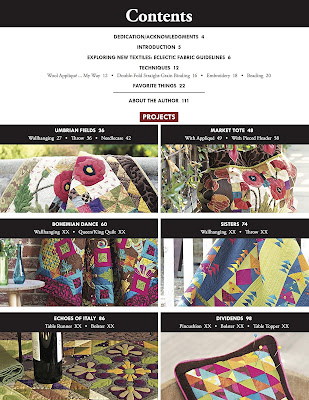
| The Art of Mixing Textiles in Quilts / Lynn Schmitt Lafayette, CA: C&T, c2018 111 p. |
This book is a great resource. The first section talks about the different non-quilting cotton fabrics that the author uses, like wool, silks, linen, or upholstery fabrics, among others. She goes over the best ways to use and combine these fabrics -- tips on seam pressing, stitching, interfacing/stabilizing, and so on. One good example of a basic tip is when sewing heavier fabrics like wool or upholstery weights, don't press the seams to one side. Press open to reduce bulk, and you can also grade seams. This is something garment sewists will probably know but it's a great tip for someone new to incorporating these fabrics.
I'm mostly interested in this topic because it seems to me that this book has lots of great ideas that can be used in garment sewing, especially these days as patchworked and quilted clothing is becoming a little more popular once again. And I feel like there is a lot of useful content here. Plus beautiful images, did I mention that already?
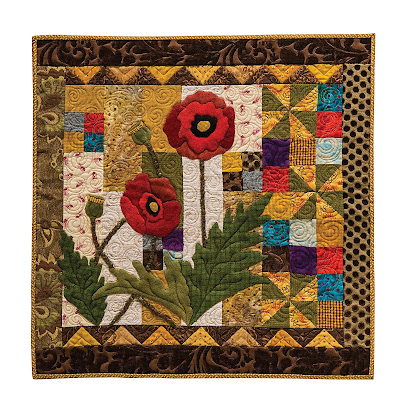
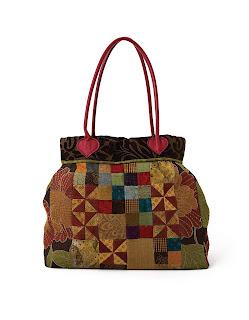
Her style of eclectic piecing as she calls it is really eye-catching, as is shown off with 14 projects here -- pillows, quilts and small projects which feature piecing, applique and some wonderful quilting designs too. One piece that uses both traditional blocks and more modern design is this beautiful little wall hanging. I love the combo of colours, techniques, and the overall finish.
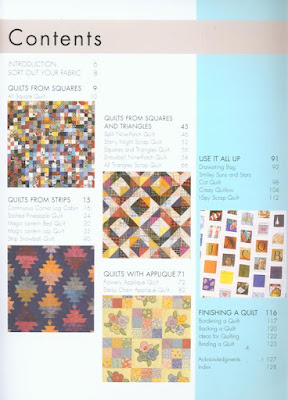
| Making Scrap Quilts to Use It Up! / Lynne Edwards Newton Abbot, Devon: David & Charles, c2003 128 p. |
One of the ways to sew more sustainably is to make sure you're using as much of your fabric as possible, and wasting very little of it. Making quilts has always been a traditional way of doing this. However, I'm not really a quilter, well, not a traditional one anyhow. So I don't end up using a lot of my scraps in this way.
But, I recently saw a book review on PatternReview for this book, Making Scrap Quilts to Use It Up by Lynne Edwards. The reviewer mentioned that along with quilts this book includes two other small projects, in particular, a bag that she was interested in.
It sounded so intriguing that I quickly requested this book on Interlibrary Loan and have had a chance to read through it over the last week or so. It is a good collection, with a variety of quilts (16 patterns) using small pieces, arranged either randomly or in set quilt patterns that give great visual effects. There are good photos and clear diagrams and instructions for the projects as well.
One of my favourite kind of quilts is the random scrap style, and the first one in this book is a massive postage stamp quilt -- all made of 1.5" squares. It's really appealing, the kind of scrap celebration I love. There is also a quillow pattern, I recall making a bunch of these for Christmas gifts many years ago!
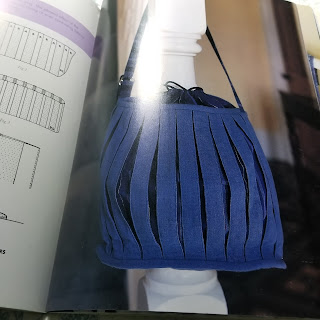
But as I am mainly a garment sewist, I have to agree with the original reviewer that the highlight of this book is the very unusual bag pattern. It's a pleated bucket bag style, with an interior drawstring closure. I haven't seen a style like this before, and there are examples both in solid fabric and in patchworked fabrics. I don't make many bags but this is such an interesting design that I'm eager to give it a try.
This book is out of print as far as I can tell, so you'll have to find it second hand or via your own local library if you are interested in investigating it as well.
![]() |
| Last Minute Patchwork & Quilted Gifts / Joelle Hoverson NY: STC Craft, c2007. 160 p. |
![]() |
| elegant pillows |