Sunday, September 29, 2019

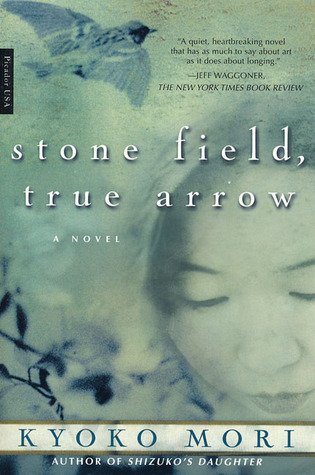
Weekend Review: Stone Field, True Arrow

Stone Field, True Arrow / Kyoko Mori
New York: Picador, 2000.
288 p.
I picked up this book by chance recently, mostly because of a mention in the blurb that the main character is a weaver and makes clothes. These things always interest me! Later I realized that I'd also read her YA novel Shizuko's Daughter,  many years ago.

This is the author's debut adult novel, and while it is was interesting there were flaws in my reading experience.

Maya Ishida left her artist father in Japan when she was sent to live with her estranged mother in the US when she was only a child. She's always found her mother harsh and unloving, and missed her father and Japan so much that she has become an emotionally withdrawn adult.

She's created a comfortable life for herself, finding a job in a small clothing boutique, and an apartment/studio above it as her refuge. Strangely enough, she's also found a husband, a local high school teacher who isn't demanding but is also still enmeshed with his ex-wife.

Maya is detached from all of this, from life, from her relationship with her husband (which eventually breaks down, not surprisingly; there seems to be no emotional connection between them at all). But she meets someone else, a man full of spirit and energy who is also an artist -- what she has always aspired to, though she has settled into her life of weaving wearables as her art form. I found it strange that at one point Maya seems to disregard her own weaving, which has been commented on multiple times already in the book as unusually beautiful and artistic, as a secondary choice to her ideal of "real" art, painting. As a textile focused maker myself, I believe that weaving, sewing, quilting ARE art and are not secondary to painted art. Maya is a weaver; she is an artist. The author's choice in making this statement was unclear in the plot for me.

This is a very quiet, muted book. The plot has a few emotional eruptions, both positive and negative -- but there seem to be many failed relationships throughout, not just Maya's own - and Maya never leaves behind her extreme detachment from everything around her. Of course, the word Maya is also a Buddhist term for the illusory nature of the world, so perhaps that detachment is an integral part of this character.

In any case, I found this a satisfying read, though a slow one. I was in the right mood for it, and the elements around weaving, yarn, and clothing were engaging and beautifully told. The characters themselves were a bit sad sack and there is no emotional resolution to the story, which I would have preferred to see. So, while uneven and not fully satisfying, I still wanted to finish this and see what happened to all these characters. Perfect if you are looking for a quiet melancholic read as we move into the fall.


Friday, September 27, 2019

Literary Sewing Circle: Author Feature

photo by Latrippi  via Flickr
Today we'll be looking at the author of our current Literary Sewing Circle pick. Ruth Ozeki is a multi-talented author, film-maker, and Zen Buddhist priest.

 She's also a part time university instructor. As shared on her academic bio for Smith College:

Ruth Ozeki is an award-winning author, filmmaker and Zen Buddhist priest whose novels have garnered international critical acclaim for their ability to integrate issues of science, technology, environmental politics, philosophy and global pop culture into unique hybrid narrative forms. Her best-selling novel A Tale for the Time Being (2013) won the Los Angeles Times Book Prize and was shortlisted for the 2013 Man Booker Prize and the National Book Critics Circle Award; it has been translated and published in more than 35 countries. Her earlier novels, My Year of Meats (1998) and All Over Creation (2003), were both New York Times Notable Books.

Her earlier novels -- My Year of Meats and All Over Creation -- are both concerned with the environment, with identity, with community, just like this latest novel. My Year of Meats was my first introduction to her writing, and I really loved it. So I'm happy to share this latest novel with you, too. 

Interviews:

Ruth Ozeki on books in life and in her fiction

Ruth Ozeki talking about author interviews and A Tale for the Time Being

Ruth talks about libraries with the Public Library Association in the US

And there is a wonderfully thought-provoking talk that you can listen to that Ruth Ozeki gave as part of her work at Smith College, all about the connections between Buddhism and autobiographical writing. It's nearly an hour & a half, so get a cup of tea ready and settle in!


*******************************************

Now, there is something else about this author that I think we sewists might be particularly interested in. Ozeki is not only a writer, filmmaker and intellectual, she's also an ordained Buddhist priest. As part of that process, she was required to sew her ordination robes herself,  by hand. She talks a bit about this in this article:

Confessions of a Zen Novelist

In this article, she refers to sewing her Rakusu. This is a miniature version of the Buddha's robe, a bib-like piece sewn by students as they are preparing for the ceremony in which they'll receive their Bodhisavatta precepts: more on this here, including a nice clear photo of a Rakusu.

The Brooklyn Zen Centre has shared an interesting article on the sewing of the Rakusu, including a lovely quote about the importance of sewing in Buddhism from Tomoe Katagiri,  a well-known Zen Buddhist sewing teacher. And then you can read a full-length interview with Katagiri all about her life as a Buddhist sewing teacher. It is really moving; one stitch at a time, just like life, that's Zen stitching.

The next item that Ozeki sewed was her Okesa, her ordination robe. What is an Okesa exactly? You can find out here.

Once again, the Brooklyn Zen Centre has a nice set of photos of an Okesa that the students there sewed as a group for one of their priests.

If you are particularly interested in the theory behind the importance of the role of sewing in Buddhist practice, you can find a discussion in a forum which talks about the process of sewing okesa -- a comment notes that sewing is zazen, too! I think many of us could agree with that.

And you can even find an online copy of Tomoe Katagiri's book on Buddhist sewing, which covers the why and wherefores of fabric sourcing, colours to be used, designs and techniques, how and why to sew and to wear these items, and the purpose of it all. If you are really keen on finding out more about sewing as a Buddhist practice, this is a great read. But please note that these items are only to be sewn with the permission of a Zen teacher, in the steps involved in one's serious Buddhist study.

I hope that this gives you a little more to think about as we keep reading. We can continue to consider our own sewing and its place in our lives as we read.


Sunday, September 22, 2019

Weekend Review: I Am Cute Dresses

I Am Cute Dresses / Sato Watanabe
translated by Asako Ohashi
Loveland, CO: Interweave Press, c2011.
120 p.
This week I'm sharing yet another title from my collection of Japanese pattern books. I can't resist these when I find them either 2nd hand or while thrifting. Even if I don't use them, they are so pretty to look at!

This book is by Sato Watanabe, an author I wasn't aware of before finding this book. It's not a Tuttle book, rather it has been published by Interweave. There are a few differences in production choices, primarily that this book has no Westernized pull out patterns in the back. It is more traditional; all of the patterns have schematics that you then use to draw up your own patterns. It's more work to do it this way, for sure -- but the drafting skills are good to learn, and it's really just taking written instructions and measurements and drafting them out into an actual pattern piece. So if you're up for that, there's lots of good stuff here.


But, the sizing in this book is also a big difference from other Japanese sewing books I've read -- all of the schematic drawings are based on an average bust measurement of 35-36", and an average hip measurement of 38-39". There are points marked by a star on the pattern drawings as good points to resize for your body when making up a pattern. This size range reflects the Japanese source of this book; I'm larger than the average that this is working from, but close enough that sizing up isn't too much of a chore, especially since all the patterns are boxy, loose fitting, easy-tailored styles intended to have a "one size fits all" aesthetic. 

Of course, I'm not entirely sure that these kind of loose fit dresses will suit those who are not petite Japanese sewists, but I do find a couple of the patterns charming enough to give it a go. Like most of these books, the 25 designs are shown in photographs with brief descriptions in the beginning of the book, followed by a glossary and sewing tips, which includes an explanation of the sizing protocol, and also has a list of the pattern markings and what they mean on the drawings. This is very helpful as they aren't standard markings -- ie, where to identify the fold of the fabric, where to match up pattern pieces and so on.


And then the dresses are all shown in more detail with the pattern information and instructions in the last half of the book.

While it's a different way to approach a sewing book than the hand-holding beginner sewing books that many Western sewists are used to, I think that an experienced sewist won't have too much trouble. The patterns are intentionally simple, with few fussy shapes or techniques to worry about on the pattern making side. When this was first published in English in 2011, I'm not sure that the oversize look was as popular as it is now (ie: the popularity of the StyleArc Adeline or the Wiksten Shift reveal more appeal in the loose fit for contemporary sewists). So this book might have more currency now than at first.


In any case, I enjoyed looking through this and think that the pattern drafting challenge might be a way for me to up my sewing skills somewhat. I do like a number of the styles so might try it out and see what happens.

but what is with this weird pose on the back?


Friday, September 20, 2019

Literary Sewing Circle: Inspiration!


It's the first week of this round of the Literary Sewing Circle and time for some inspiration! Have you got your hands on a copy? Have you started reading yet? 

I thought I'd start us off with the most obvious inspiration -- the setting! This book has two primary settings, Tokyo and a small island on the BC coast. 

Let's start with Japan. If you take that as your source of inspiration, you can go in many directions. 

You might think about using Japanese fabrics to make your project. Nani Iro, Lecien fabrics, Kobayashi, Echino, NekoNeko -- there are many brands, lines, or shops that specialize in Japanese fabrics. Here are few lovely ones.

Probably the best known source for Japanese fabric is Miss Matabi. Lots of choice and great shipping rates too. There are a wide variety of designs to choose from, from cute to elegant to colourful.


 There are also some wonderful Japanese shops, like FabricTales. Gorgeous fabrics shipped from Japan from traditional to modern, florals to "japanesque" designs. She even sells fabric cords. I'm coveting some of that!


Then there is our own Canadian online shop FabricSpark, who sells a line of Japanese fabrics along with all the other wonderful things she stocks.


If you don't want to include Japanese themes just in your fabric choices, you could think about incorporating some Japanese inspired techniques into your project, like Shibori

photo by Agistadler via Flickr

or Sashiko


or even fabric origami! There is a whole book on this, and lots more out there online.


There are many Japanese patterns you could use also. Any of the very popular Japanese Pattern Books are a good start! There are also Japanese pattern magazines, though those will likely be easier to use if you can read Japanese.


Or of course you could take a look at the patterns by Japanese pattern designer, and our Literary Sewing Circle sponsor, Yuki from Waffle Patterns. Don't forget, anyone who posts a finished project by our due date of November 15 will be entered into a draw to win a 30 Euro voucher from Waffle!


There are lots of patterns at Waffle that match with this book, from fabulous outerwear to delicate daily tops and either slim or wide leg pant options too.

***********************************

There are also other areas to explore for your inspiration. If you are caught by the elements of the story that take place in B.C., you might want to use a pattern from a company based in BC as well. Of course there is Helen's Closet to inspire you. I can imagine her Suki Robe in a soft Japanese cotton lawn for summer!


You could explore In House Patterns from BC too -- her soft bow blouse would mix well with some luscious printed Japanese fabric.


You might want to make a jacket for hiking in the rainy outdoors, as the characters Ruth and Oliver find themselves doing often. A good choice might be the Minoru Jacket by Sewaholic, also a BC pattern company!


And of course, for lots of outdoor suitable clothing especially for men, check out BC based Thread Theory


If you just want to get your fabric from BC, you can always take a look at Blackbird Fabrics -- who, incidentally, has some nice Japanese non-stretch denim in right now!


Do you have any ideas yet? Are your plans jumping to mind or are you waiting until you've read the book to the end before you decide what to make? I hope lots of ideas are sparking for you already. If you have any favourite shops, fabrics or patterns that I've missed in this post, feel free to share them in the comments!


Tuesday, September 17, 2019

Scraptember!


September seems to be the month of scrappy sewing over on Instagram -- I am still intending to sew along with #scrappySeptember via the Make A Garment A Month group. To that end, I've been trying to decide on a project!

I do love to use up my larger offcuts by putting them together into something else, and I especially love print blocking, when it's done right. I don't sew with too many solids so don't do a lot of solid colour blocking -- just because I don't have many of those scraps to work with.

I was thinking about some of the ways in which I might use some of my larger remnant pieces for this September's scrappy challenges, and that led me to investigate which patterns I already own that might fit in well with this technique. It turns out I have quite a few. So I thought I'd share them with you for inspiration. If you have any patterns that you find helpful for this kind of project, please share them in the comments.

This is a pattern that I just bought; couldn't resist the silhouette or the scrappy potential!
Now this is a pattern I've had for a very long time, and I've made View A before. It might be time to try the short sleeved View B and use up a few interesting pieces of scrap fabric.


I just bought this one is our local fabric store's amazing moving sale. I had missed it altogether so was happy to pick it up now that I am thinking of scrappy sewing. It's made for lightweight fabrics but I'm thinking that maybe some velvety bits might work too... 


McCalls 7466
It's obvious in this pattern that View D is specially created for scrappy goodness! I can imagine it in wild print blocking -- that would be fun. There is a denim version like the pattern cover over on PatternReview; someone actually made this one and it is so fun.


Another pattern that I just picked up in our local sale. I'm not a huge Marcy Tilton fan, but I'm willing to give this one a try. I really like the simplicity of View C -- maybe this one could use up some of the larger solids in my stash, of which I have only a few!

This might be perfect for some of the smaller pieces of lightweight fabrics like challis or crepe in my scrap pile. I like a nice oversize pullover top and this one looks cute to me.

I've had this one for ages, a pretty Zandra Rhodes design that I bought thinking of a Christmas dress. But many holidays have come and gone and I still have not made it...Perfect for those glitzy bits!


You can't quite tell with this one unless you look at the line drawings, but there are
 multiple  seam lines here to help you break up the fabrics you choose. I think it would look 
nice with some subtle scrappiness in the fabric choice.


Obviously the jacket is the leftover fabric project in this wardrobe pattern. You could make
 all the other pieces and then use the leftover bits to make a matching jacket. 
Or just make a jacket  on its own with all the remnants currently in your stash. 


Any of these patterns would be fun to try! Maybe it would reduce my scrap stash.

Then of course, I might always try a Bargainista copy of my favourite Dior dress of the past few years:


Take a look at the whole show for more inspiration!


What about you? Do you like print blocking? Colour blocking? Do you like to save and use your scraps?


Sunday, September 15, 2019

Weekend Review: Happy Homemade Sew Chic


Happy Homemade Sew Chic / Yoshiko Tsukiori
trans. from the Japanese by Masashi Karasawa
North Clarendon VT: Tuttle, c2013.
64 p.
This week's feature is another book by Yoshiko Tsukiori -- I think she is my favourite so far among all the Japanese pattern books I own. Her style is casual, natural, and just quirky enough for me. 

In this book she shares 20 patterns, most for dresses or tunics, though there are some pants and jackets in here too.

Like her other books, this one has Westernized pattern sheets in the back to trace. The size ranges up to a bust size of 40 1/4" and hip size of 43 3/4". So while it's a limited sizing, it is larger than many other Japanese sewing books. I just squeak into the largest sizes here. The patterns are fairly boxy and geometric, though, so if you have any experience at all with altering patterns, you should be able to adapt them upward to some larger sizes.

As usual, my favourite patterns here are for dresses. All of these on the back cover appeal to me --  although the black one, upper centre, (Dress R) is the one that I'd like to make first. 

Even with that, the lower right is a linen jacket that has kind of caught my eye as well. I might have to make something that -- gasp -- isn't a dress! The reliance on linens, natural cottons and lovely prints is so appealing.
Here's a better view of the jacket
I like this series, and hope to find all of them someday. I just have to find the time to trace all of the appealing designs so I can break out my ditsy prints. I love the solids, but the one below looks so prairie retro. It's funny that there is that similarity.

This reminds me of a prairie apron
Anyhow, I recommend this one for the inspiration, and for the variety of designs in it. Between the pants, skirt, blouse, jacket and many dresses/tunics, you could make yourself an entire wardrobe with just this book. Also, the patterns are basic enough that many variations could be made to shake them up a little, too. 

If you're interested in Japanese sewing books, this one is a good bet to start with. I'm hoping to share my own Dress R before the end of this year! 


Friday, September 13, 2019

Literary Sewing Circle: A Tale for the Time Being


Fall has arrived, and with it our Literary Sewing Circle autumn round! I'm really thrilled to have both a wonderful Canadian book as our featured read, and an amazing sponsor too!

I'm happy to announce that our group read for this round of the Literary Sewing Circle is

A Tale For The Time Being by Ruth Ozeki


Summary:

In Tokyo, sixteen-year-old Nao has decided there’s only one escape from her aching loneliness and her classmates’ bullying, but before she ends it all, Nao plans to document the life of her great-grandmother, a Buddhist nun who’s lived more than a century. A diary is Nao’s only solace—and will touch lives in a ways she can scarcely imagine.

Across the Pacific, we meet Ruth, a novelist living on a remote island who discovers a collection of artifacts washed ashore in a Hello Kitty lunchbox—possibly debris from the devastating 2011 tsunami. As the mystery of its contents unfolds, Ruth is pulled into the past, into Nao’s drama and her unknown fate, and forward into her own future. 

Full of Ozeki’s signature humour and deeply engaged with the relationship between writer and reader, past and present, fact and fiction, quantum physics, history, and myth, A Tale for the Time Being is a brilliantly inventive, beguiling story of our shared humanity and the search for home.

(from Goodreads)

About Ruth:

A longtime Buddhist practitioner, Ruth was ordained in 2010 and is affiliated with the Brooklyn Zen Center and the Everyday Zen Foundation. She lives in British Columbia, and New York City.

Her first two novels, My Year of Meats (1998) and All Over Creation (2003), have been translated into 11 languages and published in 14 countries.

Her most recent novel, A Tale for the Time-Being (2013), won the LA Times Book Prize, was shortlisted for the Man Booker Prize and the National Book Critic’s Circle Award.

(excerpted from Ruth Ozeki's website)

photo by Latrippi


This book is available for purchase in both hard copy and ebook formats, as well as in audiobook format (read by the author!)

You can find many formats at all of these locations:

Amazon.ca

Amazon.com

Amazon.co.uk

Amazon.com.au

Book Depository

IndieBound

Chapters Indigo

Powell's

Barnes & Noble

Biblio.com

ABE Books


Or, of course, check your local library!


**************************************************

How does the Literary Sewing Circle work? We read a book together, discuss it, and then make something inspired by our reading. As long as you can point out what inspired you from your reading, even if just a sentence, you can share your makes in our final roundup!

Anyone can join, and you can sew, knit, quilt or embroider - any textile art that you like doing - to participate. This is a reading/sewing circle, very low-key; no competitions here, just reading and sewing for fun. Although we are very lucky to have a special sponsor offering this time around -- one of the finished projects will be chosen at random to receive the free pattern offering. Just finish and post your project by the end of the linkup and you will have a chance to win.

There is no official sign-up to worry about; just start reading along if you wish, and leave your thoughts on the book or your project on any of the Literary Sewing Circle posts. We do have a dedicated book discussion post halfway through and again at the end, but leave your thoughts anytime. And when the final post goes up, so does the project linkup -- you can leave a link to your finished project there, whether it is on your blog, a pattern site, or even Instagram. It's easy :)

So, join in, and share!


Literary Sewing Circle Schedule

Sept 13 - Announcement & Introduction

Sept 20 - Inspiration post & featured sponsor

Sept 27 - Author feature

Oct 4 - Halfway mark: book talk

Oct 11 - Inspiration post

Oct  18 - Final Post: book discussion wrap up & posting of project linkup

(The project linkup will be live until November 15 - a month - so you have enough time to get your project posted)

******************************************

And now for our sponsor! 


Yuki of Waffle Patterns has agreed to sponsor this round of the Literary Sewing Circle! Waffle Patterns are chic modern styles with a Japanese flair, and can be purchased via the Waffle website. 

Waffle Patterns has just released a new jacket pattern, the Arare pullover, a classic anorak style jacket which is currently on sale as a launch deal. Check it out!


Anyone who reads along and posts a link to their finished project by Nov 15 will be eligible for the draw to win a 30 Euro coupon to the Waffle store! (~3 patterns). Get your projects in to have a chance for this great sponsor offer. Thank you Yuki!

My favourite Waffle pattern: the Snowball Dress!

Thursday, September 12, 2019

Literary Sewing Circle Coming Soon!


The Literary Sewing Circle title choice will be announced here tomorrow morning! 

I am excited about our new read and hope you will be too.

Tuesday, September 10, 2019

Spotted Gauze Sorbetto

Hazy summer day!
I bought some double gauze in the sale at my local fabric store -- I've had my eye on this particular bolt for a long while but when I finally decided to buy some there was only one metre left.

So what to do? Make another TNT -- that I way I know it will use the fabric well and it will fit me.

Excuse my squinty eyes -- I just got back from the eye doctor!
So I got out my Sorbetto pattern and went back to a variation I've used before when I have barely a metre of fabric to play with. I lay it out with the pleat placement line for the front actually on the front fold, to eliminate the pleat and fit the top onto limited fabric.

And I use an old add-on short sleeve pattern.


It worked -- it just fit onto this small piece of polka dotted double gauze. I made a few changes due to the fabric though. I sewed it all using French seams, to avoid any fraying or separating along the seam lines. It gives such a nice finish. With a 5/8" seam allowance, I like to sew my first go at 1/4", trim that down to about 1/8" and then finish it off with a 3/8" final seam. Trimming the first line helps to avoid loose threads and fabric coming through the final stitching.


I didn't want to press this much, since I wanted to keep the hand nice and crinkly, so to hem the sleeves and bottom, I stitched a line at 1/4" then just folded it up at that line and over again, finger pressing and then stitching it down. I then gave it all a light press with steam and that got all of the waviness out of the hems.


To finish the neckline, I magically had the perfect denim blue cotton bias binding in my stash that I thrifted a while back. I finished it with the binding and gave it another gentle steam press to get the neckline smoothed out. The binding is slightly heavier in weight that this airy fabric so it did sag outward a bit, but I think the pressing fixed most of that.

This was a straightforward make that I took a little extra time with to use the fabric to its best advantage. I'm glad I went a bit more slowly because I really love this finished top.


Sunday, September 8, 2019

Weekend Review: Sewing Happiness

Sewing Happiness / Sanae Ishida
Seattle: Sasquatch Books, c2016.
240 p.
This is a different kind of craft book. It's about the author's journey from corporate intensity to a chronic illness to finding a new and balanced way to live. She does this partly through craft. 

When the stress and full on nature of her corporate job leads Ishida to develop Graves' disease, a thyroid dysfuntion, she has to re-evaluate her life and find a way to heal herself without filling herself with drugs. 

She finds that eating better -- healthy foods, mindfully prepared and eaten -- sleeping properly, and sewing are her routes back to better health (to a point; Graves disease is irreversible). The meditative nature of sewing reduces her stress and lets her feel competent at something again, both important to her mental health. She decides that she's going to spend a year sewing all of her daughter's clothes. (this does not sound relaxing to me, but perhaps for a high achiever it helped to have this kind of concrete goal). 

Knit Tank Dress

Her story is moving, and it makes this book more than it would be otherwise. It's a good approach for other busy corporate mom kind of readers who are looking or needing to make a life change. Especially if they are new to sewing and need encouragement to begin.


The projects are loosely arranged around the seasons, twenty projects in all. They range from a pillow or a bag to yoga pants or children's dresses, but they are all focused on comfort and making your life beautiful. Ishida is inspired by the simplicity and aesthetic of her Japanese heritage, even including some sashiko stitching in a few projects.


I think that the project I found most unique was an easy fortune cookie advent calendar -- while I probably wouldn't make a whole advent calendar, I like the idea of the fortune cookie and can imagine lots of ways to use it in other settings. 

The projects are all simple -- nothing challenging for someone who has sewn before. But something to note is that none of the projects have patterns, per se. Like many Japanese sewing books there are measurements in the back of the book for each project, alongside hand drawn instructions. The basic nature of most of the projects makes this feasible for sure, although the yoga pant & knit dress are odd ducks for me -- you're told to trace a garment that you already have. So I guess if you want to make those projects you'd better already have some ;) 

In any case, although the projects are mainly home dec items and I probably won't end up making any of them, I did find the book soothing and honestly told, with beautiful photography throughout. If you can find it at your library it's definitely worth a look. 

Origami Pillows